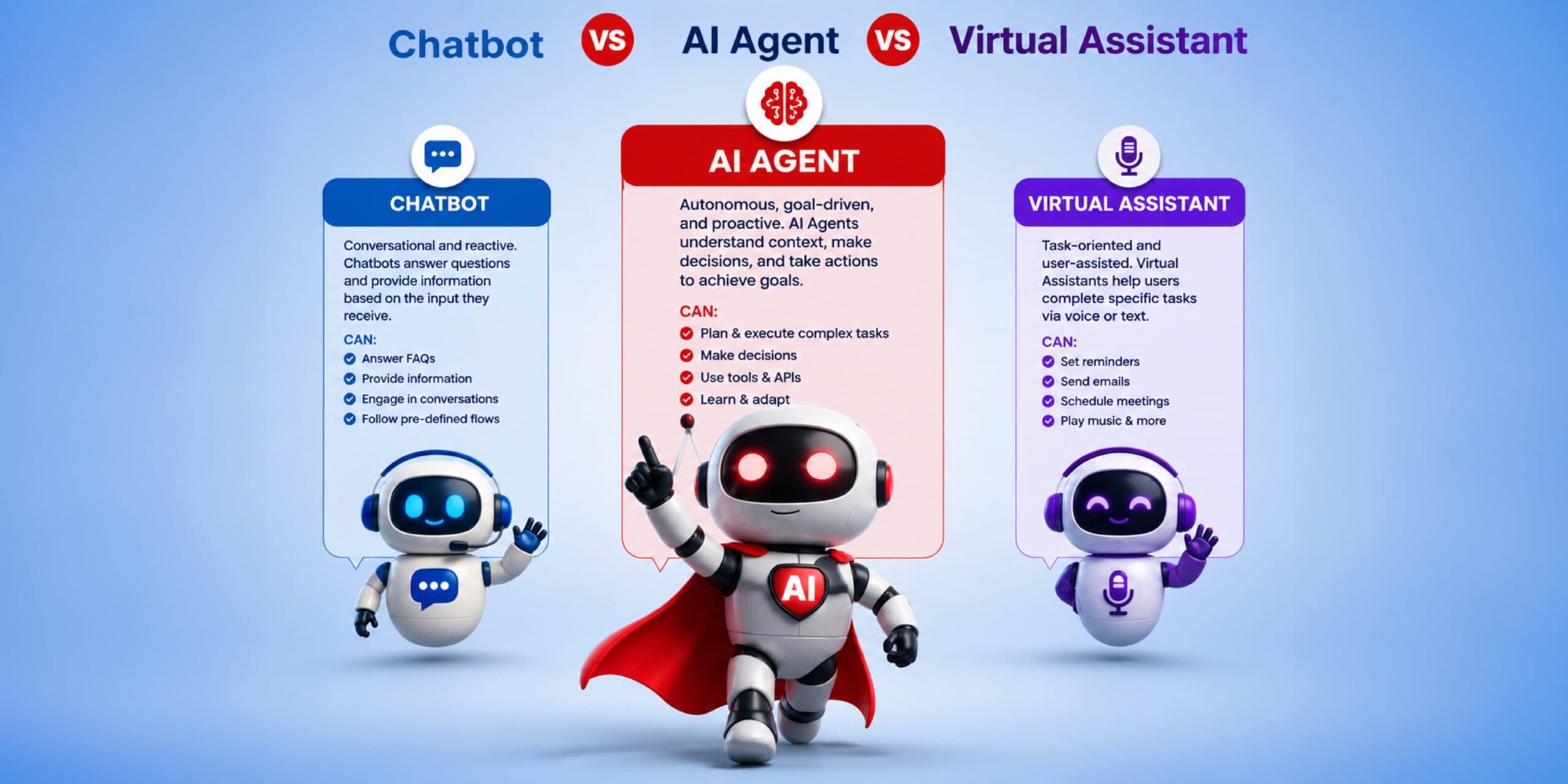
Chatbot vs AI Agent: Differences, Advantages, and Which Is Better for Your Business


Executive Summary & Value Proposition
- Different Approaches: Chatbots operate on simple rule-based systems, whereas AI Agents are powered by context-aware generative artificial intelligence.
- Execution Capability: Chatbots only provide static responses, while AI Agents can execute end-to-end business workflows autonomously.
- System Integration: AI Agents feature deep integrations with the WhatsApp API, CRM platforms, payment gateways, and inventory systems.
- Target Use Cases: Chatbots are ideal for simple FAQs, whereas AI Agents act as “digital employees” for growing enterprises.
The “chatbot vs. AI Agent” debate is surfacing more frequently, especially as many businesses realize traditional chatbots easily hit dead ends, struggle to understand conversation context, and cannot complete tasks end-to-end.
However, not every process requires an AI Agent. There are scenarios where traditional chatbots remain more efficient, stable, and cost-effective. To avoid poor decision-making and wasted implementation costs, it is essential to understand their fundamental differences, how they work, and their impact on service performance and business operations.
What Is a Chatbot?
A chatbot is an automated system that answers messages based on pre-defined rules, decision trees, or pre-built templates.
How Traditional Chatbots Generally Work
- Relies on rigid rules, keywords, or menu selection logic.
- Lacks deep or long-term conversation context comprehension.
- Cannot make new decisions outside designed scenarios.
- Cannot execute complex workflows across systems without complicated custom integrations.
When Chatbots Work Well
- Repetitive inquiries that require no complex reasoning (FAQs).
- Highly simplified and structured processes.
- High-volume operations with low problem variance (e.g., operating hours, location checks, or static catalogs).
What Is an AI Agent?
An AI Agent is an LLM-powered generative AI system that doesn’t just answer messages, but understands context, makes decisions, executes workflows, and interacts directly with other business software.
Core Capabilities of an AI Agent
- Comprehends natural language completely (Natural Language Understanding/NLU).
- Retains and dynamically utilizes long conversation context.
- Makes decisions based on a combination of business rules and adaptive AI logic.
- Executes operational procedures: real-time stock checks, complaint ticket generation, follow-ups, and customer data updates.
- Acts as a “digital employee” through agentic AI capabilities that resolve tasks from start to finish.
Key Differences: Chatbot vs. AI Agent
| Evaluation Aspect | Traditional Chatbot | Modern AI Agent |
|---|---|---|
| Core Mechanism | Rule-based (decision trees / keywords) | Generative AI + Autonomous Workflow Engine |
| Language Understanding | Limited to specific keywords | Contextual Natural Language Understanding (NLU) |
| Conversation Context | Does not retain long-term context | Capable of following complex, long-form conversations |
| Execution Capability | Answers messages only | Answers messages + executes operational tasks |
| System Integration | Highly limited | Deep integration (Connected to CRMs, APIs, Payments, ERPs) |
| Decision Making | Rigid, cannot process new inputs | Flexible, determines optimal steps based on context |
| Failure Handling | Hits dead ends easily (“Sorry, I don’t understand”) | Adaptive and handles smooth escalation to human agents |
Case Study: Delivery Complaint Resolution Workflow
To understand their practical differences, let us compare a delivery complaint handling workflow between a standard chatbot and an AI Agent:
Traditional Chatbot Workflow
- Asks for tracking number → customer mistypes format → chatbot fails to understand.
- Chatbot repeatedly requests the correct format without offering a solution.
- If a complex issue arises (stuck package / missing courier updates), the chatbot cannot assist.
- Customer gives up and leaves negative feedback → triggers manual escalation to human CS.
Modern AI Agent Workflow
- Customer sends an unformatted message → AI Agent understands intent context.
- AI Agent checks delivery status in real-time via logistics APIs.
- If an issue exists (e.g., delayed delivery), the AI Agent automatically creates a complaint ticket.
- AI Agent provides resolution estimates and dispatches periodic status updates.
Result: First Contact Resolution (FCR) time drops significantly, support team workload decreases, and Customer Satisfaction (CSAT) scores increase sharply.
Pros and Cons Analysis
Advantages of Chatbots
- Stable and consistent for large-scale, repetitive inquiries.
- Ideal for presenting static information (opening hours, store addresses).
- Initial implementation costs tend to be lower.
- Extremely low risk of generating false answers (hallucinations).
Advantages of AI Agents
- Handles complex cases independently without human intervention.
- Executes cross-system automation like syncing data with a CRM system, payment gateways, and inventory software.
- Reduces customer service operational workload by 60–85%.
- Fully integrates with official channels via the WhatsApp Business API and omnichannel application.
Selection Guide: When to Use a Chatbot vs. AI Agent?
Use a Chatbot If:
- Customer inquiries are simple and highly repetitive.
- Required answers are 100% based on static templates.
- Business processes do not require complex logic flows.
- Conversation volume is moderate with a strictly limited initial budget.
Upgrade to an AI Agent If:
- End-to-End Automation Is Needed: Registrations, warranty claims, KYC, appointment bookings, and automated follow-ups via workflow automation.
- Multi-System Integration Is Required: Connections to CRMs, inventory software, or payment gateways are essential.
- High Problem Resolution Without CS: Support teams are overwhelmed by daily chat queues.
- High Chatbot Failure Rates: If 20–40% of chat interactions end with “Sorry, I don’t understand,” it is a clear indicator to upgrade to an AI Agent.
Start Using AI Agents with Cekat.ai
The era of rigid chatbots has passed its peak. Businesses aiming to increase service speed and cost efficiency are shifting to AI Agent platforms capable of executing operational work.
The Cekat.ai platform enables your enterprise to run intelligent AI Agents capable of:
- Comprehending natural conversation context and making autonomous decisions.
- Executing operational business workflows independently 24/7.
- Integrating directly with the WhatsApp Business API, CRMs, payment gateways, and internal company systems.
Start transforming your business operations today with Cekat.ai.
Frequently Asked Questions (FAQ)
1. What is the main difference between a Chatbot and an AI Agent?
Chatbots operate on a structured rule- or keyword-based model to deliver static responses. Meanwhile, AI Agents use LLM-based artificial intelligence to understand conversation context, make adaptive decisions, and execute cross-system tasks automatically.
2. Can an AI Agent replace human customer service agents completely?
AI Agents resolve up to 80% of routine tasks and complex inquiries independently. However, for issues requiring deep empathy or special decision-making outside base policies, AI Agents seamlessly escalate to human agents along with complete context history.
3. Is implementing an AI Agent more expensive than a standard chatbot?
While initial AI Agent investments may be higher than standard chatbots, the generated Return on Investment (ROI) is significantly greater because AI Agents resolve operational tasks (high FCR) and save CS operational costs at scale.
4. How fast can an AI Agent be implemented for a business?
Using no-code platforms like Cekat.ai, businesses can configure and integrate an AI Agent with the WhatsApp API or CRM in a matter of days using pre-built templates.
Read next: Understanding the AI Agent Platform: Core Components Every Modern Business Must Have