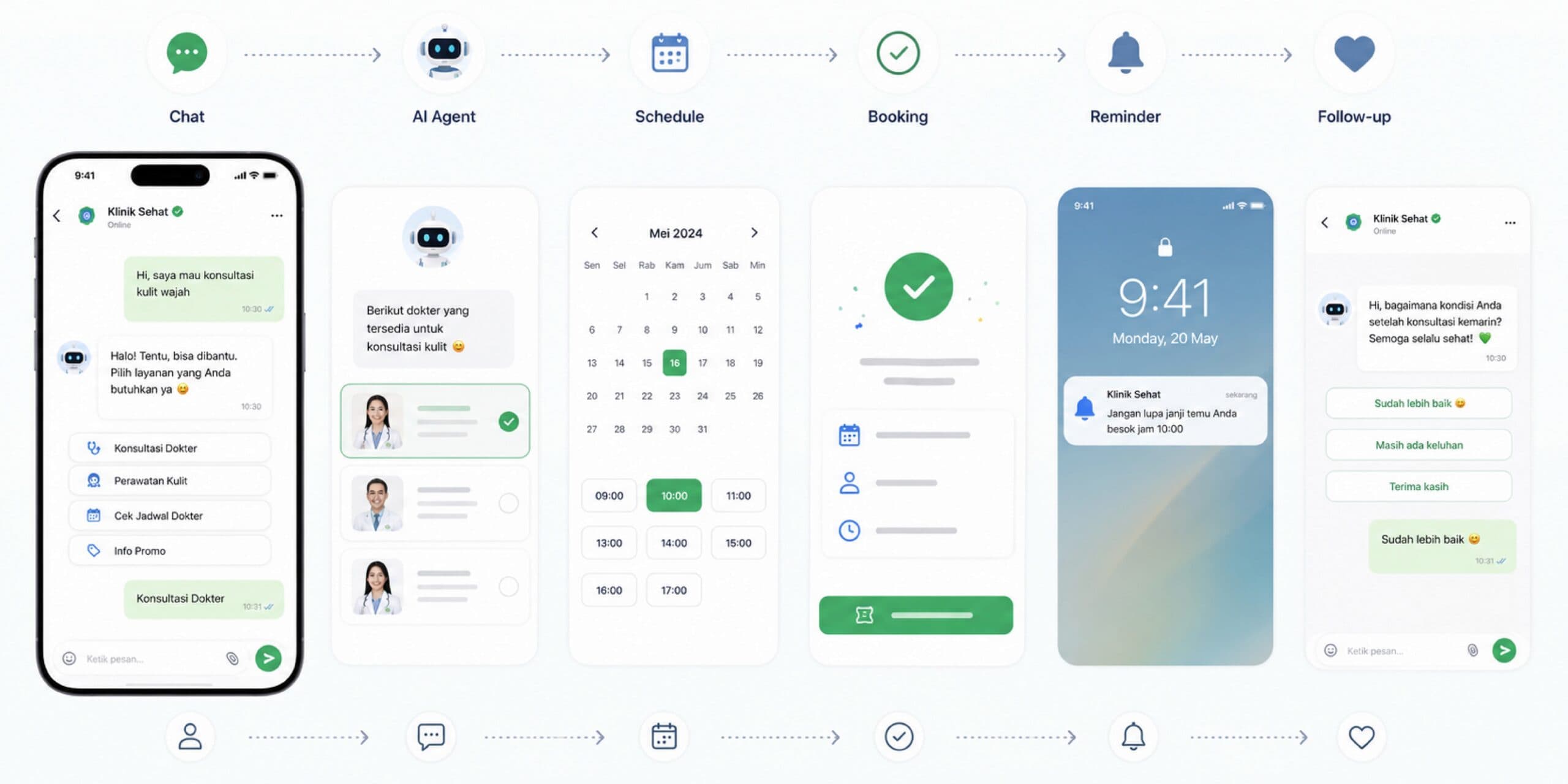
The Difference Between AI Agent, Chatbot, and Virtual Assistant: Which One Is Right for Your Business?

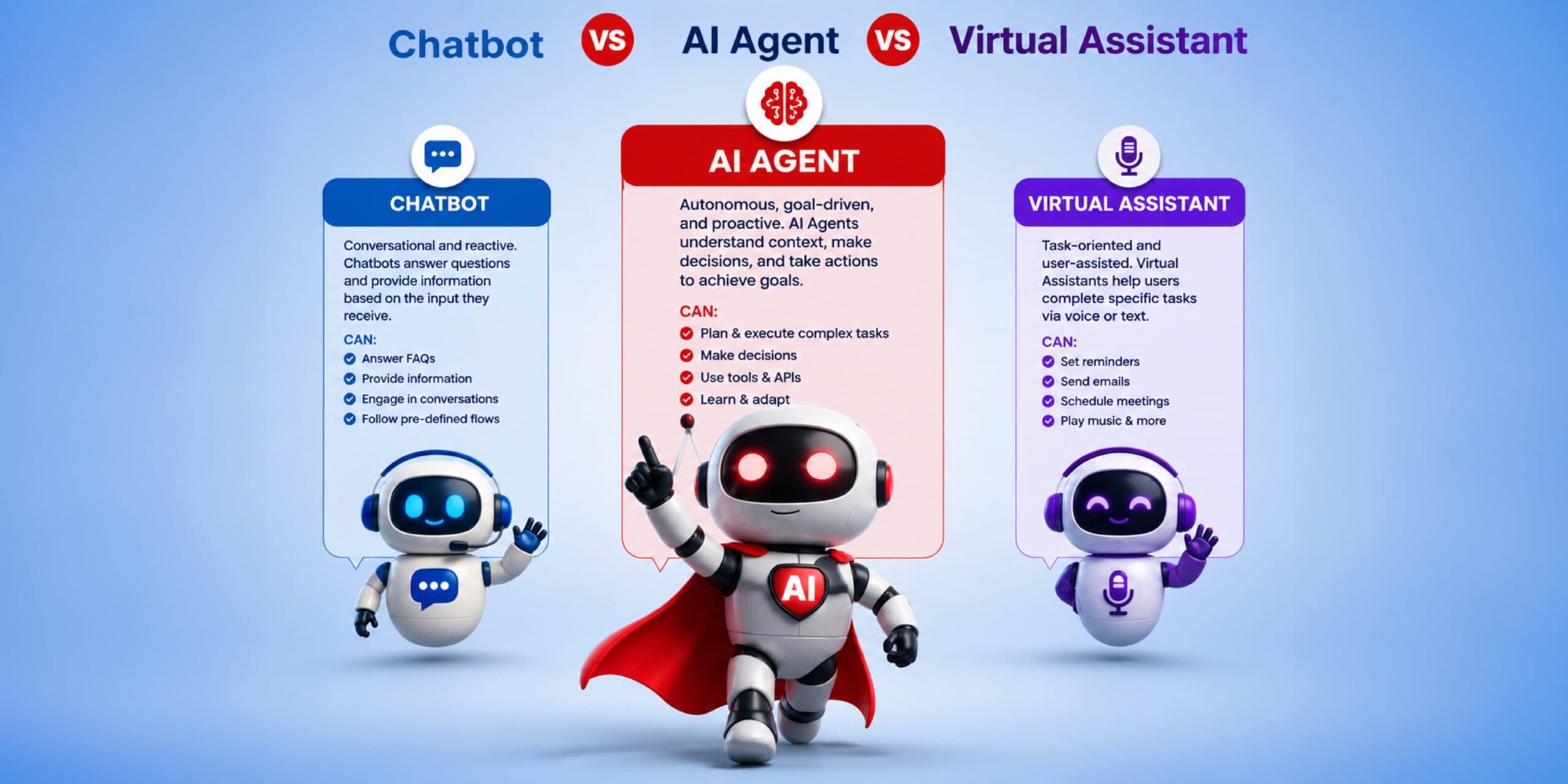
In recent years, more and more businesses have started using automation technology to respond to customers faster, reduce manual work, and increase conversion opportunities. However, amid the popularity of terms like chatbot, virtual assistant, and AI agent, many business owners and decision makers still consider the three to be the same thing. In reality, from how they work, their level of intelligence, their ability to understand context, to their impact on operations and revenue, the three have fairly fundamental differences.
Understanding the difference between AI agent, chatbot, and virtual assistant for business is important because the wrong technology can keep business processes feeling manual, even though they appear to be “automated.” Many companies feel they already have a chatbot, but customers still have to wait for a human admin to resolve their issue. There are also businesses that use a virtual assistant, but its function is still limited to answering simple questions, not truly helping customers move from inquiry to transaction. This is where the AI agent becomes a more advanced category, because it doesn’t just answer, it also understands intent, takes action, runs workflows, and helps businesses complete processes more independently.
At Cekat.AI, we see that the main challenge for modern businesses is no longer simply “how to reply to chats faster,” but how every customer conversation can be managed, understood, followed up on, and converted into more measurable revenue. That’s why the discussion of chatbot vs AI agent can’t stop at conversational technology alone. The difference has to be seen in how far the system can help a business work more efficiently, more consistently, and stay better prepared for a constantly increasing volume of customer interaction.
Rule-Based Chatbot: Good for Simple Answers with Fixed Patterns
A chatbot is the most common form of conversational automation used by businesses. In many cases, a chatbot works on a rule-based system, meaning it responds to customers based on predetermined rules, keywords, or conversation flows. For example, when a customer types “price,” the system shows a price list. When a customer selects “check order,” the chatbot asks for the invoice number. When a customer asks something outside the available template, the chatbot usually fails to understand the context and redirects the customer to a human admin.
The advantages of a rule-based chatbot are that it’s simple, quick to implement, and fairly effective for highly repetitive customer service needs. For businesses that only want to answer basic questions like operating hours, store address, payment methods, or simple order status, a chatbot can be a reasonable starting solution. However, its limitations start to show once customers ask questions in more natural language, with more complex context, or with needs that don’t fully follow the flow that was designed.
In a business context, a rule-based chatbot is often the first step toward automation. But if your business’s customer journey already involves many channels, many types of inquiries, many variations in needs, and follow-up processes that affect conversion, a chatbot alone usually isn’t enough. This kind of system can help reduce the burden of simple questions, but it isn’t necessarily able to maintain engagement quality, understand customer intent, or help the business follow up on sales opportunities more strategically.
Virtual Assistant: More Flexible, but Still Often Limited to Task Help
A virtual assistant is one level more flexible than a rule-based chatbot. Generally, a virtual assistant is designed to help users carry out specific tasks, such as scheduling meetings, giving reminders, looking up information, directing customers to a particular service, or helping answer questions in a more natural style. Where a rule-based chatbot depends heavily on a rigid flow, a virtual assistant usually has better language understanding and a more conversational interaction experience.
However, in a business context, a virtual assistant doesn’t always mean a truly structured system. Many virtual assistants still work as a “digital assistant” that helps with certain tasks, but aren’t necessarily able to make operational decisions, manage customer data comprehensively, run automatic follow-ups, or connect conversations to a CRM system and business workflow. In other words, a virtual assistant can feel smarter than a chatbot, but isn’t necessarily strong enough to become an operational layer with a direct impact on revenue.
A virtual assistant is well suited for use when a business needs digital help to speed up administrative tasks or simple, more personal interactions. For example, helping a customer choose a consultation schedule, answering general questions in more natural language, or giving initial direction before a customer is handled by the sales or customer service team. But once a business starts needing a system that can understand intent, manage leads, update customer status, run follow-ups, and support the conversion process, that need has already moved into AI agent territory.
AI Agent: A System That Doesn’t Just Answer, It Acts for the Business
An AI agent is artificial-intelligence-based software that can understand context, determine the next step, and act in a structured way to complete business tasks. Unlike a chatbot that only responds based on a certain flow, an AI agent can read customer intent, understand conversation history, adapt its responses to customer needs, run workflows, manage data, and help the business move from conversation to more concrete action.
In practice, an AI agent for business doesn’t only act as a chat responder. An AI agent can help filter leads, identify customer needs, gather important information, schedule meetings, give product recommendations, run automatic follow-ups, update the CRM, and even help teams spot revenue opportunities that previously went unnoticed within chats. This role is far more strategic than an ordinary chatbot, because an AI agent works as part of the business’s operational system, not just as an add-on feature on a communication channel.
At Cekat.AI, we position the AI agent as a layer that helps businesses connect conversation, customer data, automation, and the revenue process within a single platform. For us, a customer conversation isn’t just a chat that needs a reply, it’s a source of intent that needs to be captured, understood, and followed up on. This is why the AI agent is becoming an increasingly relevant choice for businesses that want to improve response time, improve follow-up quality, reduce manual work, and make sure no customer opportunity is lost along the way.
The Difference Between AI Agent, Chatbot, and Virtual Assistant for Business
To make it easier to understand, the difference between AI agent, chatbot, and virtual assistant for business can be seen in how they work, their ability to understand context, their flexibility, and their impact on operational processes. A chatbot is usually suited to answering basic questions. A virtual assistant is suited to helping with certain tasks with a more natural experience. An AI agent is suited to businesses that need a more advanced system, one that can understand conversations, take action, and run business processes more independently.
Comparison Aspect
Rule-Based Chatbot
Virtual Assistant
AI Agent
Main way of working
Follows a predetermined flow, keywords, and rules
Helps with certain tasks through more natural interaction
Understands context, determines the next step, and carries out business actions
Level of intelligence
Limited to scenarios that have already been built
More flexible, but still task-based
More advanced because it can understand intent and take action
Natural language understanding
Low to moderate, depending on the scenario
Moderate to high
High, especially when connected to business data and context
Ability to understand customer context
Limited
Partial, depending on integration
Stronger, because it can read history, intent, and customer status
Ability to run workflows
Very limited
Limited to certain tasks
Can run business workflows such as follow-up, tagging, routing, CRM updates, and escalation
Best suited for
Simple FAQs, operating hours, basic info, service menus
Scheduling, reminders, initial guidance, administrative help
Lead qualification, customer engagement, sales follow-up, CRM automation, and revenue workflows
Impact on revenue
Indirect
Partially supports the process
More direct, because it helps capture, manage, and convert customer intent
Limitation risk
Easily fails when a question falls outside the flow
Still needs a human for many decisions
Requires the right platform and setup to work optimally
Example use
“What time does the store open?” and the chatbot answers automatically
“Let me help you schedule your consultation”
“I understand your needs, gather the necessary data, update the CRM, then schedule a follow-up with the sales team”
From this table, it’s clear that the chatbot vs AI agent discussion isn’t just about which one is more modern. The difference lies in the business role each one can play. A chatbot answers. A virtual assistant helps. An AI agent works. For businesses that still have low conversation volume and simple needs, a chatbot may still be enough. But for businesses that already have many leads, many channels, many admins, and many revenue opportunities that need following up, an AI agent is a far more relevant choice.
Rule-Based vs AI: The Difference Lies in the Ability to Understand Intent
One of the most important differences between a traditional chatbot and an AI agent lies in the rule-based vs AI approach. A rule-based system works on the logic of “if the customer asks A, then answer B.” This approach is effective as long as customers ask questions that match a predicted pattern. But in business reality, customers rarely speak in a neat format. They may ask using mixed language, incomplete sentences, shifting context, or needs that aren’t yet clear from the start.
AI works with a more adaptive approach. An AI agent can understand the intent behind a customer’s message, not just read keywords. For example, when a customer writes, “I need something I can pay for next month but the item ships this week,” a rule-based chatbot may struggle to determine a response if there’s no matching keyword. An AI agent can pick up that the customer is talking about a payment need, a shipping timeline, and a potential transaction. From there, the system can ask follow-up questions, provide relevant information, or direct the customer to the right process.
For business owners and decision makers, this difference matters a great deal because the quality of a customer’s response directly affects trust, the speed of decision-making, and conversion opportunities. When a system only answers based on a template, the customer experience can feel rigid. But when a system is able to understand needs and follow up on conversations contextually, the business has a much better chance of holding onto customer interest before that intent fades.
When Is a Chatbot Enough for a Business?
A chatbot is still relevant for businesses with simple conversational needs and highly repetitive question patterns. If most customers only ask about basic information such as address, operating hours, service list, payment methods, or a catalog link, a rule-based chatbot can help reduce the admin’s workload. This kind of system is also well suited for early-stage businesses that want to try automation for the first time without deep integration complexity.
However, a chatbot becomes less ideal once a business starts facing more dynamic conversations. For example, customers asking for product recommendations based on personal needs, comparing services, requesting a specific promo, asking about stock availability under specific conditions, or needing to be guided into the purchase process. In situations like these, a chatbot often only serves as the initial entry point, while resolution still depends on a human admin.
In other words, a chatbot is a good fit when your business objective is basic response efficiency. But if that objective has grown into improving conversion, maintaining consistent follow-up, managing leads, and reducing revenue leaks from unhandled conversations, then it’s time for the business to start considering an AI agent.
When Is a Virtual Assistant the Better Choice?
A virtual assistant is the right choice when a business needs digital help that’s more personal than a chatbot, but doesn’t yet need a system that runs the full business workflow. For example, a virtual assistant can help customers pick a consultation schedule, send appointment reminders, give initial direction, or help customers find certain information in a more natural way.
In service businesses, clinics, education, financial services, hospitality, or B2B, a virtual assistant can help create a more comfortable experience in the early stage of interaction. Customers don’t feel like they’re talking to an overly rigid system, while the internal team benefits because part of the administrative process can be automated. However, the effectiveness of a virtual assistant still depends on how deeply that system is connected to business data and processes.
If a virtual assistant stands alone without a connection to a CRM, omnichannel inbox, customer segmentation, automation, or sales pipeline, its impact stops at the level of conversational help. The business may appear more responsive, but not necessarily more measurable. That’s why many companies eventually need a more integrated platform, namely an AI agent platform that can work across conversations, data, and workflows.
When Does a Business Need to Upgrade to an AI Agent?
A business needs to upgrade to an AI agent when customer conversations have become too important a revenue source to manage manually. The signs usually show up as rising chat volume, an overwhelmed admin team, inconsistent response time, leads slipping through the cracks, delayed follow-ups, and difficulty knowing which campaign is actually generating sales. At this stage, the business problem is no longer just “chats going unanswered,” but “customer intent failing to convert into revenue.”
Upgrading to an AI agent also becomes important once a business has many communication channels. Customers may come from ads, the website, WhatsApp, Instagram, live chat, marketplaces, referrals, or events. If each channel is managed separately, customer data ends up scattered and the team struggles to see the full picture of the customer relationship. An AI agent connected to an omnichannel platform and a CRM can help unify that context, so every conversation isn’t isolated but becomes part of a more measurable customer journey.
In addition, an AI agent becomes relevant when a business wants to reduce its dependence on manual processes. In many companies, admins have to answer repetitive questions, record customer data, add tags, remember follow-ups, hand leads over to sales, and update statuses manually. Processes like these are error-prone, hard to scale, and difficult to monitor. With an AI agent, most of these processes can be handled automatically, so the human team can focus on more strategic decisions, more complex cases, and opportunities with higher transaction value.
Business Condition
Solution That’s Still Sufficient
The Right Time to Upgrade
Customer questions are still simple and repetitive
Rule-based chatbot
No need to upgrade yet if there’s no follow-up or CRM requirement
Customers need help with scheduling or initial guidance
Virtual assistant
Upgrade if the process after scheduling is still manual and frequently leaks
High lead volume from ads or campaigns
AI agent
Needs an upgrade because speed-to-lead and follow-up affect conversion
Chats coming in from many channels
AI agent + omnichannel platform
Needs an upgrade so data and conversations don’t get scattered
Admin overwhelmed answering chats and recording data
AI agent + CRM automation
Needs an upgrade to reduce manual work and human error
Follow-ups are often late or inconsistent
AI agent + workflow automation
Needs an upgrade because revenue opportunities can be lost after an inquiry
Management struggles to see lead performance through to revenue
AI agent platform
Needs an upgrade so the business has clearer visibility
Why an AI Agent Is More Relevant for Decision Makers
For business owners and decision makers, conversational technology shouldn’t be judged only by how quickly the system replies to a message. What matters more is how much that technology helps the business reduce operational costs, improve the customer experience, increase conversion, and provide clearer visibility into the revenue pipeline. From this perspective, an AI agent carries far greater strategic value than an ordinary chatbot or a standalone virtual assistant.
A chatbot can help reduce repetitive questions. A virtual assistant can help create more natural interactions. But an AI agent can become part of the business’s growth system because it works more closely with customer intent, customer data, and the sales process. An AI agent helps a business understand who its incoming customers are, what they need, how far along their intent is, what action should be taken next, and how that process can be followed through without relying entirely on humans.
For decision makers, this means the business gains not just automation, but control. Control over response time. Control over follow-up quality. Control over customer data. Control over the pipeline. And ultimately, control over revenue that was previously often lost to manual processes, scattered communication, or inconsistent follow-up.
Cekat.AI as a More Advanced AI Agent Platform for Businesses in Indonesia
Cekat.AI exists as an AI Agent platform designed to help Indonesian businesses manage customer conversations, automate the customer journey, and turn interactions into insight and more measurable revenue opportunities. We see that businesses in Indonesia face very specific challenges: customers active across many channels, high chat volume, rising expectations for fast responses, and operational teams that often still have to manage all of it manually.
That’s why Cekat.AI doesn’t position AI merely as an add-on chatbot. Cekat.AI builds the AI agent as part of a customer engagement and revenue platform that can help businesses capture customer intent, manage conversations across channels, save data to the CRM, run follow-ups, and help teams view business processes in a more centralized way. With this approach, the AI agent isn’t just a tool for answering questions, it becomes a system that helps the business work faster, tidier, and more scalably.
As the most advanced AI Agent platform in Indonesia for business, Cekat.AI understands that a company’s needs don’t stop at automated responses. Businesses need a system that can bring together WhatsApp, Instagram, live chat, and other channels into a single workflow. Businesses also need a CRM that lets every customer be recognized, tagged, grouped, and followed up on. Meanwhile, marketing and sales teams need automation so that every lead not only comes in, but also moves toward conversion.
With Cekat.AI, businesses can build a faster customer experience without losing context. Teams can reduce manual work without losing control. Decision makers can see the customer journey more clearly without having to rely on fragmented reports. This is the big difference between using an ordinary chatbot and adopting an AI agent platform that’s genuinely designed to support business growth as a whole.
An AI Agent Doesn’t Replace the Team, It Strengthens the Business System
One concern that often comes up when businesses start discussing AI is whether the technology will replace human roles. In a business context, a more accurate way to look at it is to see the AI agent as something that strengthens the working system, not a total replacement for humans. An AI agent helps handle repetitive work, reads initial intent, gathers information, runs follow-ups, and makes sure the process doesn’t stall just because the admin is busy or chat volume is high.
Human teams remain essential for handling complex cases, building strategic relationships, negotiating, making decisions, and giving a personal touch to high-value customers. But with an AI agent, teams are no longer burdened by repetitive administrative work. They can work with tidier data, clearer priorities, and fuller customer context.
For a business, the combination of an AI agent and a human team creates a more efficient operating model. Customers get a fast response. The team gets system support. Management gets visibility. And the business gets a much better chance of protecting revenue that would otherwise be lost in the middle of a manual process.
Conclusion: The Choice of Technology Should Match Business Complexity
The difference between AI agent, chatbot, and virtual assistant for business lies in the depth of function and its impact on operational processes. A rule-based chatbot is suited to answering simple questions with fixed patterns. A virtual assistant is suited to helping with certain tasks through a more natural interaction experience. An AI agent is suited to businesses that need a more advanced system, one that can understand intent, take action, run workflows, and help connect conversations to revenue.
If your business is still at an early stage and only needs automated responses to basic questions, a chatbot may already be enough. If your business needs more natural conversational help for certain tasks, a virtual assistant can be the right choice. But if your business is already facing high lead volume, many communication channels, inconsistent follow-up, scattered customer data, and revenue opportunities that often slip away after a customer reaches out, then it’s time to upgrade to an AI agent.
At Cekat.AI, we believe the future of customer engagement isn’t just about replying to chats faster, it’s about building a system that can understand, manage, and convert every customer interaction into more measurable business growth. With AI agent, omnichannel, CRM, and automation in a single platform, Cekat.AI helps Indonesian businesses move from mere automated responses toward smarter revenue operations.
If your business is considering when the right time is to upgrade from a chatbot or virtual assistant to an AI agent, now is the right moment to take a closer look at your customer journey process. Get a free consultation with the Cekat.AI team and discover how an AI agent can help your business respond faster, follow up more consistently, and turn more conversations into revenue.
Read next: Chatbot vs AI Agent: The Fundamental Difference Every Business Must Understand