
In recent years, the term AI agent has come up more and more often in business conversations. Many companies are starting to talk about automation, chatbots, CRM, omnichannel, workflow automation, and even integrating AI into customer service, sales, marketing, and operational processes. However, the more technology that emerges, the more terminology sounds technical and confusing, especially for businesses just starting to explore the use of AI.
We put together this AI agent glossary to help business owners, operations managers, customer service teams, marketing teams, sales teams, and decision makers who want to understand AI platform terminology in plain language. The goal isn’t to make the technology feel complicated, but to help businesses see how each term directly relates to work efficiency, response speed, service consistency, customer data quality, and revenue growth.
Why Do Businesses Need to Understand AI Agent Terms?
Before getting into the list of terms, it’s important to understand that an AI agent isn’t just a technology trend. In a business context, an AI agent is part of the operational infrastructure that can help a company respond to customers, automate workflows, manage data, run follow-ups, connect conversations with a CRM, and help human teams focus more on things that require strategic decisions.
The problem is, many businesses are interested in using AI but don’t yet share a common language when evaluating their needs. Some call every automated system a chatbot. Some assume an AI agent can only answer questions. Others haven’t yet understood that a modern AI agent platform needs to be able to connect with communication channels, a CRM, workflows, an analytics dashboard, and other operational systems.
This is where a business automation glossary becomes important. By understanding business automation terminology more clearly, a business can distinguish features that are genuinely important from features that just sound appealing. Businesses can also more easily discuss things with their internal team, technology vendors, consultants, or an AI platform like Cekat.AI when designing an implementation that fits their actual needs on the ground.
1. AI Agent
An AI agent is an artificial-intelligence-based system that can understand instructions, read context, make decisions, and carry out certain tasks automatically to support business processes. Unlike an ordinary chatbot, which generally only answers based on simple rules, an AI agent is designed to complete work more actively — for example, answering customer questions, collecting lead data, running follow-ups, routing conversations to the right team, or helping customers move from inquiry to transaction.
In a business context, an AI agent matters because today’s customers expect fast, personal, and consistent responses. As chat volume rises, human teams are often overwhelmed trying to handle all conversations manually. An AI agent helps businesses maintain service quality without always having to add admins in a linear way. At Cekat.AI, the AI agent is positioned as part of a customer engagement system that helps businesses work faster, in a more structured way, and more scalably.
2. Rule-Based Chatbot
A rule-based chatbot is a chatbot that works based on predetermined rules or scenarios. This type of chatbot usually uses menu options, specific keywords, or a static conversation flow. If a customer asks something outside the prepared pattern, the chatbot often can’t give a relevant answer.
This term is important to understand because many businesses still equate a rule-based chatbot with an AI agent. In reality, the two have different capabilities. A rule-based chatbot is suitable for simple needs like answering basic FAQs or directing customers to a certain menu. However, for conversations that are more natural, flexible, and require understanding context, businesses usually need a more advanced AI agent.
3. Virtual Assistant
A virtual assistant is a digital assistant that helps users complete certain tasks, such as answering questions, scheduling, giving recommendations, or helping with administrative processes. In business, a virtual assistant is often used to support customer service, sales support, internal admin, or other operational needs.
The difference from an AI agent lies in the depth of integration. A virtual assistant can help complete a task, but an AI agent is usually designed to run a broader workflow, connect with customer data, and take action based on conversation context. If a virtual assistant helps a user do something, an AI agent can become part of the business system that works actively behind the scenes.
4. NLP or Natural Language Processing
NLP, or Natural Language Processing, is a technology that allows a computer system to understand, process, and respond to human language. In the context of an AI agent, NLP helps the system understand customer messages even when the sentences aren’t always tidy, formal, or in a predetermined format.
For example, a customer might ask, “Hi, is this product still available?” or “Is this ready stock?” or “Can it be shipped today?” In terms of meaning, these questions can all point to the same need — checking product availability. With NLP, an AI agent can recognize the intent behind these language variations and give an appropriate response. For Indonesian businesses serving customers with diverse communication styles, NLP is an important foundation for making conversations feel more natural.
5. NLU or Natural Language Understanding
NLU, or Natural Language Understanding, is a part of NLP that focuses on understanding the meaning of human language. If NLP helps a system process language, NLU helps the system understand the intention, context, and purpose of a message a customer sends.
In business practice, NLU helps an AI agent distinguish whether a customer is asking about price, filing a complaint, requesting payment help, looking for a product recommendation, or wanting to talk to an admin. This capability matters because a single customer sentence can carry different meanings depending on the context. With good NLU, an AI agent doesn’t just read words, it also understands the customer’s need behind the conversation.
6. Machine Learning
Machine learning is a technology that allows a system to learn from existing data and patterns to improve its performance over time. In the world of AI agents, machine learning can help a system recognize patterns in customer questions, understand the types of inquiries that come up often, and improve response quality based on interaction data.
For a business, machine learning matters because customer needs aren’t always static. The questions that come up today can be different from next month, especially when a business runs a new campaign, launches a new product, or faces a shift in market trends. With a system that can learn from data, an AI agent can become more adaptive in supporting business operations.
7. LLM or Large Language Model
LLM, or Large Language Model, is an AI model trained using language data at a massive scale so it can understand and generate text more naturally. This technology is one of the main foundations behind many modern AI systems, including AI agents that can respond to conversations in a more human-like way.
In a business context, an LLM helps an AI agent answer questions more flexibly, form more natural sentences, and understand complex conversation context. However, using an LLM in business still needs to be combined with a knowledge base, workflow, permission management, and good system controls so the AI’s responses stay accurate, safe, and aligned with company standards.
8. Knowledge Base
A knowledge base is the information hub an AI agent uses to answer questions or carry out tasks. Its contents can include product information, prices, customer service SOPs, shipping policies, payment guides, FAQs, service data, and other relevant internal information.
For a business, a knowledge base is very important because the quality of an AI agent’s answers depends heavily on the quality of the information provided. If the knowledge base is incomplete or unstructured, the AI agent risks giving inaccurate answers. At Cekat.AI, the knowledge base helps businesses make sure the AI agent answers based on information that matches the company’s needs and operational standards.
9. Intent Detection
Intent detection is a system’s ability to recognize a customer’s purpose from the message they send. In business conversations, customers don’t always express their need in a clear sentence. Some ask about price, some compare products, some want a refund, some want to complain, and some are actually ready to buy but haven’t said so directly.
With intent detection, an AI agent can understand the direction of the conversation and determine the next response or step. For example, if a customer shows buying intent, the system can guide them toward the ordering process. If a customer files a complaint, the system can create a ticket or escalate it. If a customer is just looking for information, the system can answer based on the knowledge base. This term is one of the most important concepts in the AI agent glossary because it directly relates to customer experience quality.
10. Entity Recognition
Entity recognition is AI’s ability to recognize specific pieces of information within a conversation, such as a customer’s name, order number, location, date, product, payment amount, or the type of service being asked about. This information can then be used to run a follow-up process more accurately.
For example, a customer writes, “I want to check on order number 12345 that was shipped to Bandung.” From that sentence, an AI agent can recognize that “12345” is the order number and “Bandung” is the shipping location. In business, this ability helps the system pull important data from a conversation without having to ask the customer to repeat the same information over and over.
11. Context Awareness
Context awareness is an AI agent’s ability to understand the context of a conversation, not just read one message in isolation. That means the system can remember the flow of a previous conversation within one session and respond based on information the customer has already given.
In customer service, context awareness is very important because customers don’t want to explain their needs again from the start. If a customer has already mentioned the product they’re looking for, the shipping location, or the issue they’re facing, the AI agent needs to be able to use that information to continue the conversation. With good context, interactions feel more personal, efficient, and less rigid.
12. Conversation Flow
A conversation flow is a designed path that guides a customer from one stage to the next. In business, a conversation flow can be used to answer FAQs, collect customer data, qualify leads, help with ordering, handle complaints, or route customers to a human team.
A good conversation flow doesn’t just make an AI agent look neat, it also helps a business reach its operational goals. For example, for a sales team, a conversation flow can be designed so a customer doesn’t stop at the price-inquiry stage but is guided into a consultation, product recommendations, and finally a purchase. For a support team, a conversation flow can help classify a customer’s issue before it’s passed on to an admin.
13. Prompt
A prompt is an instruction given to AI so the system understands the task it needs to carry out. In the context of an AI agent, a prompt can contain direction on language style, response boundaries, what information is allowed to be used, how to respond to customers, or what action to take in a given situation.
For a business, a prompt matters because AI needs to be directed so it matches the brand’s character and operational needs. For example, a premium brand may want the AI agent to speak with a more elegant, curated tone, while a B2B business may need a more professional, concise, and solution-oriented tone. A prompt helps an AI agent maintain communication consistency across many conversations.
14. Prompt Engineering
Prompt engineering is the process of designing AI instructions so the resulting responses are more accurate, relevant, and aligned with business needs. It isn’t just about writing a command — it’s about crafting clear direction so the AI understands the context, goal, boundaries, and expected output.
In an AI agent implementation, prompt engineering helps a business avoid answers that are too generic, off-brand, or irrelevant to the operational process. A good prompt can help an AI agent answer more precisely, maintain the tone of communication, follow the SOP, and know when to hand the conversation off to a human. That’s why prompt engineering is an important part of setting up and optimizing an AI agent.
15. Workflow Automation
Workflow automation is the process of automating a business’s workflow so certain tasks can run without excessive manual intervention. In an AI agent, workflow automation can cover sending automatic follow-ups, assigning chats to the relevant team, creating tickets, updating CRM status, sending template messages, and sending payment reminders.
For a business, workflow automation helps reduce the repetitive work that often eats up a team’s time. When many processes are still manual, the risk of delayed responses, missed leads, and inconsistent follow-up becomes greater. With workflow automation, a business can make sure important processes keep running consistently, even as customer volume increases.
16. Trigger
A trigger is a condition or event that starts an automatic action within a system. For example, when a customer fills out a form, the system automatically sends a WhatsApp message. When a customer hasn’t responded for a few hours, the system sends a follow-up. When a customer selects a complaint category, the system creates a ticket and forwards it to the support team.
In business automation, a trigger helps a system act based on a specific context. A business doesn’t need to run every process manually because the system can react to customer activity automatically. A well-designed trigger makes the customer journey more responsive and structured.
17. Action
An action is what the system does after a trigger occurs. If a trigger is the cause, an action is the resulting response that gets carried out. An action can be sending a message, changing a lead’s status, adding a customer tag, creating a ticket, sending a notification to an admin, or passing data to a CRM.
In an AI agent platform, action matters a great deal because AI doesn’t just answer conversations, it also helps run business processes. With the right action, a customer conversation can connect directly to the next operational step. This is what sets a modern AI agent system apart from a simple chatbot that just stops at the conversation.
18. Escalation
Escalation is the process of forwarding a conversation or customer case to a higher level of handling. This usually happens when the AI agent can’t resolve the issue, when the customer needs human help, or when the case has a certain urgency, such as a serious complaint, a special request, or a transaction issue.
In business, escalation matters so customers don’t get stuck in an automated conversation that never resolves their issue. A good AI agent needs to know the limits of its own ability. When a situation requires empathy, negotiation, a special decision, or specific access, the system needs to be able to pass the case to a human team with full context.
19. Human Handoff
Human handoff is the process of moving a conversation from an AI agent to a human admin or agent. Unlike escalation, which can mean moving up to a certain level of handling, handoff focuses more on the transition of the conversation so the customer can be helped directly by a human.
A good human handoff should feel seamless to the customer. The admin shouldn’t need to ask everything again from the start because the system has already carried over the conversation history, customer data, and issue context. At Cekat.AI, the handoff concept matters because AI and humans should work as one system, not rigidly replace one another.
20. CRM Integration
CRM integration is the integration between an AI agent and a Customer Relationship Management system. With this integration, customer conversation data can connect to the customer profile, lead status, purchase history, segmentation, follow-up notes, and sales or support activity.
For a business, CRM integration matters a great deal because customer conversations are a valuable data source. Without CRM integration, a lot of important information just sits in chat and is hard to use for analysis or follow-up. With CRM integration, a business can turn conversations into data that’s more structured, measurable, and actionable.
21. Omnichannel
Omnichannel is an approach that connects a customer’s various communication channels into one centralized system. These channels can include WhatsApp, Instagram, website live chat, marketplaces, email, and other platforms customers use to interact with a business.
In the context of a business AI agent, omnichannel helps a company maintain consistent service across various touchpoints. Today’s customers may find a brand on social media, ask questions via WhatsApp, compare products on a marketplace, then come back to the website. Without an omnichannel system, data and conversations easily get scattered. With omnichannel, a business can see customer interactions more completely and manage them more efficiently.
22. API Integration
API integration is the process of connecting one system to another so data can be exchanged automatically. In business, an API can be used to connect an AI agent with a CRM, e-commerce platform, payment gateway, inventory system, ticketing system, or internal dashboard.
API integration matters because an AI agent becomes far more powerful when it doesn’t stand alone. For example, an AI agent connected to an inventory system can help answer product availability questions. An AI agent connected to a CRM can update lead status. An AI agent connected to a payment system can help a customer continue their payment. With the right integrations, an AI agent becomes part of a more comprehensive business operation.
23. Webhook
A webhook is a mechanism that lets a system automatically send data when a certain event occurs. If an API is often understood as how a system requests data, a webhook can be understood as how a system tells another system that something has just happened.
In business practice, a webhook can be used when there’s a new lead, a successful payment, a form submission, a created ticket, or a change in order status. That information can then be sent to another system to trigger the next process. In an AI agent platform, a webhook helps create a more real-time and responsive automation flow.
24. SLA or Service Level Agreement
An SLA, or Service Level Agreement, is the time and quality standard a business sets for handling customers. In customer service, an SLA can mean the maximum time a customer should wait for a first response, how quickly a complaint should be handled, or when a case should be escalated.
For a business, an SLA matters because response speed greatly affects the customer experience and conversion opportunity. A lead that waits too long can move to a competitor. A slowly handled complaint can erode trust. With the help of an AI agent and workflow automation, a business can maintain a more consistent SLA because some of the initial responses and processes can run automatically.
25. Ticketing
Ticketing is a system for recording and managing customer cases in the form of tickets. Every issue, complex question, complaint, or help request can be created as a ticket so its status can be tracked through to resolution.
In a business with high customer volume, ticketing helps the support team work more neatly. Without ticketing, customer cases easily get scattered across chat, email, or manual notes. With ticketing connected to an AI agent, the system can help classify issues, create tickets automatically, set priority, and forward cases to the right team.
26. Lead Qualification
Lead qualification is the process of assessing whether a prospective customer has the potential to become a buyer. In business conversations, an AI agent can help gather basic information such as the customer’s needs, budget, business size, location, urgency, or the product they’re interested in.
This process matters for a sales team because not every inquiry has the same level of buying readiness. Some customers are just asking, some are comparing, and some are already ready to transact. With lead qualification, a sales team can prioritize the most promising prospects, while the AI agent helps keep up follow-up for leads that still need to be educated.
27. Segmentation
Segmentation is the process of dividing customers or leads into specific groups based on characteristics, behavior, needs, or level of buying readiness. Segmentation can be based on the channel they came in through, the product they’re interested in, location, purchase history, engagement, or their status in the funnel.
In an AI agent and CRM, segmentation helps a business communicate more relevantly. A new customer shouldn’t receive the same message as a long-time customer. A lead that’s already interested doesn’t need to be educated from scratch. A VIP customer may need a more personal approach. With good segmentation, campaigns, follow-up, and customer service can run more precisely targeted.
28. Personalization
Personalization is a business’s ability to deliver an experience or message tailored to a customer’s needs, context, and characteristics. In an AI agent, personalization can show up as a relevant greeting, product recommendations, follow-up based on interaction history, or answers that adapt to the customer’s needs.
Personalization matters because customers don’t want to be treated like a number in a database. They want to feel understood. However, manual personalization becomes difficult when customer volume is large. With an AI agent, CRM, and structured data, a business can deliver a more personal experience in a more scalable way.
29. Analytics Dashboard
An analytics dashboard is a data view that helps a business monitor conversation performance, response, campaigns, the customer journey, and team activity. In an AI agent platform, a dashboard can help show the number of incoming chats, response time, the most frequently asked topics, lead status, agent performance, case resolution rate, and the revenue potential from conversations.
For a decision maker, an analytics dashboard matters because a business can’t optimize something it can’t see. If customer conversations are scattered across many channels and never measured, a company struggles to understand where the bottleneck is happening. With a clear dashboard, a business can make decisions based on data, not just assumptions.
30. Compliance and Data Privacy
Compliance and data privacy relate to following regulations, securing data, and protecting customer information. When using an AI agent, a business needs to make sure customer data is handled safely, system access is controlled, conversations are stored to the right standard, and data use follows applicable rules.
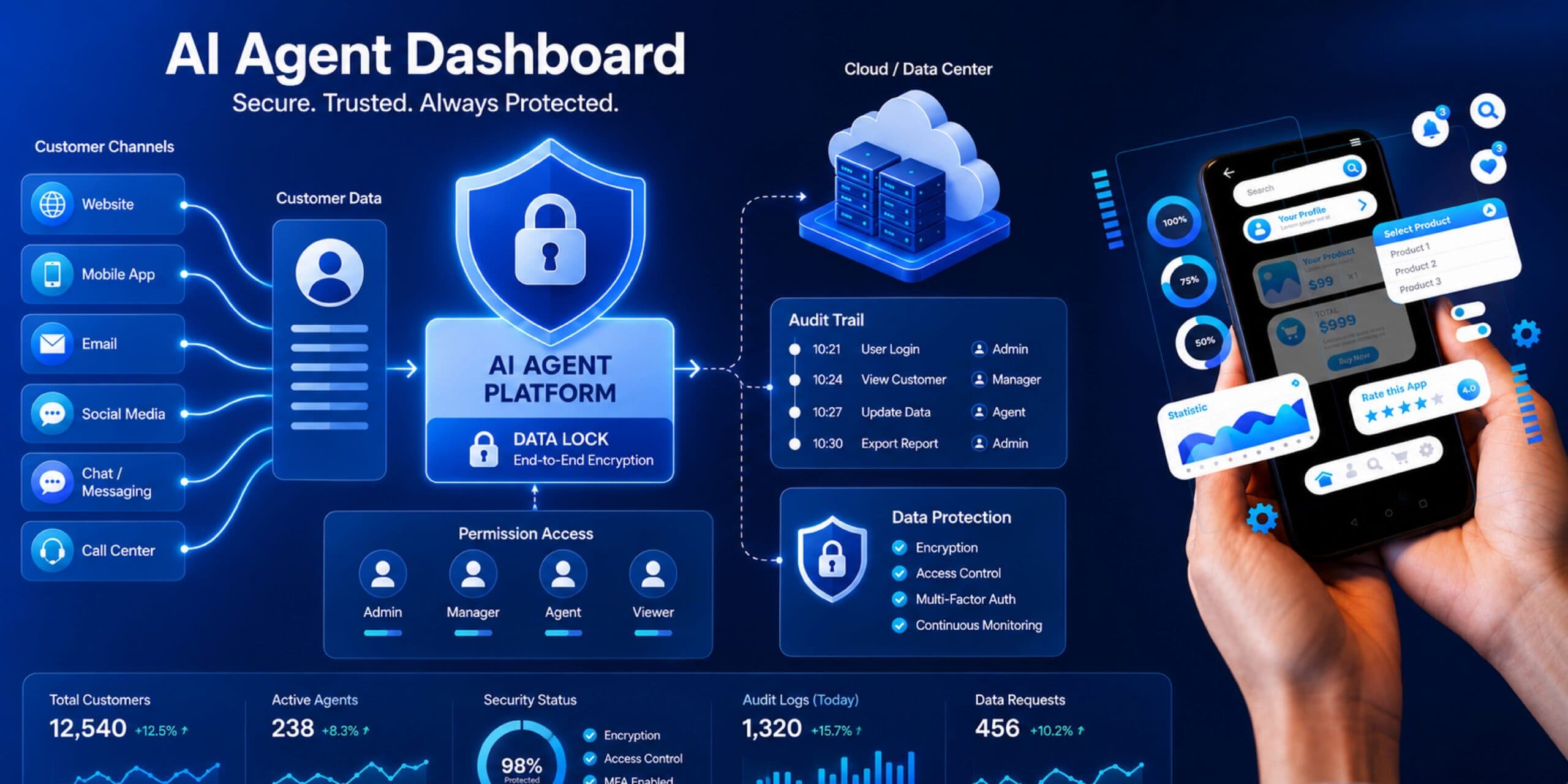
This term is very important because an AI agent often interacts directly with customer data. Information such as name, phone number, address, transaction history, or customer needs must be handled carefully. The AI agent platform a business uses shouldn’t just be sophisticated in terms of features — it also needs to take security, permission management, and compliance standards seriously. At Cekat.AI, this is an important part of our platform approach to helping businesses use AI more safely and responsibly.
How Are All These Terms Connected in Business Operations?
After understanding the 30 AI agent terms above, the most important thing is to see how they all connect to each other. An AI agent needs NLP and NLU to understand customer language. Intent detection and entity recognition help the system read the purpose and key information within a conversation. A knowledge base makes sure the answers given stay aligned with business information. Prompts and prompt engineering help maintain the communication style and response boundaries. Workflow automation, triggers, and actions make the system not just answer, but also carry out processes.
On the operational side, escalation and human handoff make sure customers can still be helped by a human when a situation needs special handling. CRM integration, omnichannel, API integration, and webhooks help keep data and business processes connected. SLA and ticketing maintain service quality. Lead qualification, segmentation, and personalization help sales and marketing teams work more relevantly. An analytics dashboard helps management see performance more clearly. Compliance and data privacy make sure every process runs to the right security standard.
In other words, an AI agent isn’t a single, standalone feature. An AI agent is part of a working ecosystem that connects customer conversations, data, workflow, human teams, and business decisions. That’s why, when choosing an AI agent platform, a business needs to look at the system’s capability as a whole, not just how smart the AI is at answering chats.
FAQ About AI Agent Terms for Business
What is an AI agent in business?
An AI agent in business is an artificial-intelligence-based system that can help a company understand customer conversations, answer questions, run automation flows, manage data, and support operational processes like customer service, sales, marketing, or support. An AI agent doesn’t just function as an automatic answering tool, it’s also a system that can help a business complete certain tasks faster and in a more structured way.
What’s the difference between an AI agent and an ordinary chatbot?
The main difference between an AI agent and an ordinary chatbot lies in flexibility, context understanding, and the ability to take action. An ordinary chatbot generally works based on predetermined rules or menus, while an AI agent can understand customer language more naturally, read intent, use a knowledge base, run workflows, and connect with other systems like a CRM or omnichannel inbox.
Why is NLP important in an AI agent?
NLP matters because customers communicate using everyday language that varies widely. Without NLP, a system would struggle to understand questions that don’t fit a set format. With NLP, an AI agent can read language variations, understand the intent of a message, and give a more relevant response. For businesses in Indonesia, this capability is very important because customers’ communication styles can be very flexible, informal, and context-dependent.
What is workflow automation in an AI agent platform?
Workflow automation is the process of automating a business’s workflow so certain tasks can run without always having to be done manually by a human team. In an AI agent platform, workflow automation can be used for lead follow-up, chat assignment, ticket creation, CRM status updates, sending reminders, or other frequently repeated processes. The goal is to make operations faster, more consistent, and more scalable.
What does handoff to a human mean?
Handoff to a human is the process where an AI agent passes a conversation on to an admin or human team. This is usually done when a customer needs special help, a case is too complex, or the situation requires human empathy and decision-making. A good handoff needs to carry over the conversation context so the admin can pick up right away without asking the customer to start over.
Why is CRM integration important for an AI agent?
CRM integration matters because customer conversations shouldn’t just end up as isolated chats. With CRM integration, data from conversations can flow into the customer profile, lead status, interaction history, segmentation, and follow-up notes. This helps a business see the customer journey more clearly and makes sales, marketing, and support processes more structured.
What are the benefits of omnichannel when using an AI agent?
Omnichannel helps a business manage various customer communication channels within one centralized system. With omnichannel, conversations from WhatsApp, Instagram, a website, a marketplace, or other channels can be managed more neatly. This matters because today’s customers often switch channels before finally buying or contacting a business. Without omnichannel, customer data easily gets scattered and becomes hard to track.
How does an AI agent help maintain an SLA?
An AI agent helps maintain an SLA by giving a faster initial response, routing the conversation into the right flow, classifying inquiries, and running automatic follow-ups. When a response doesn’t rely entirely on a human admin, a business can maintain a more consistent service time, especially when chat volume is high.
Does every business need an AI agent?
Not every business needs an AI agent at the same level of complexity, but almost every business that interacts with customers digitally can benefit from one. If a business starts experiencing piled-up chats, slow response times, missed leads, scattered customer data, inconsistent follow-up, or a team overwhelmed by communication channels, an AI agent can be a relevant solution.
How do you start using an AI agent for business?
The safest way to start using an AI agent is to map out the business processes that take up the most time, such as answering FAQs, following up leads, qualifying prospects, handling complaints, or updating customer status. After that, a business can prepare a knowledge base, define the workflow, connect communication channels, and choose a platform that can support those needs comprehensively.
Get Started with Cekat.AI, the Most Complete AI Agent Platform for Business
Understanding business AI agent terminology is the first step. The next step is choosing a platform that can turn these terms into a real working system for your business. A good AI agent doesn’t just answer chats, it also helps a business manage conversations, automate workflows, unify customer data, maintain SLAs, connect communication channels, and provide insight that can be used to make decisions.
Cekat.AI is here as the most complete AI agent platform to help Indonesian businesses build a customer engagement system that’s faster, more structured, and more scalable. With AI agent capabilities, CRM integration, an omnichannel inbox, workflow automation, analytics, and practical implementation support, Cekat.AI helps businesses turn customer conversations into a more measurable, valuable process.
If your business wants to start using an AI agent without getting lost in confusing technical terms, Cekat.AI can help you start with the most relevant needs: responding to customers faster, keeping follow-up more consistent, unifying customer data, and building operations that are ready to grow.
Get started with Cekat.AI, the most complete AI agent platform for your business.
Read next: AI Glossary for Business: 100 Essential Terms You Need to Know