Data Security in AI Agent Implementation: What Indonesian Businesses Need to Know

AI agent implementation is increasingly becoming a necessity for Indonesian businesses that want to respond to customers faster, automate conversations, speed up follow-up, and protect revenue opportunities from getting lost in still-manual processes. However, behind that efficiency potential, there’s one big question that naturally comes up for many business owners, IT teams, operations managers, and compliance teams: how safe is customer data when it’s managed by an AI agent?
This question matters because an AI agent doesn’t just answer chats. In business practice, an AI agent can read conversation context, recognize customer needs, log intent, help with segmentation, run follow-ups, connect data to a CRM, and even support the transaction process. That means an AI agent can come into contact with data that’s very sensitive for a business, from customer names, phone numbers, conversation history, product preferences, service needs, complaints, prospect status, to transaction information.
Why AI Agent Data Security Is an Important Issue for Indonesian Businesses
Many businesses start using an AI agent because they want to reduce the burden on admins, speed up response time, and make sure every customer inquiry is handled consistently. In businesses with high chat volume, especially in retail, healthcare, financial services, education, hospitality, real estate, automotive, and B2B services, customer conversations are an extremely valuable data source. From those conversations, a business can understand market needs, read purchase intent, identify customer objections, and find revenue opportunities that weren’t visible before.
However, the bigger the role of an AI agent in customer engagement, the bigger a business’s responsibility becomes for protecting customer privacy. Security risk doesn’t only come from the AI technology itself, but also from how a business manages access, stores data, connects channels, and controls who is allowed to see customer information. Many data leaks or misuses don’t always happen because the AI system is weak, but because internal workflows are messy, admin access is too broad, customer data is scattered across too many devices, or important conversations are still managed through personal accounts without adequate controls.
This is why AI agent implementation for business needs to start from a more strategic question: not just “what can the AI answer?”, but also “what data is being processed, who can access it, how is the data stored, how is the data secured, and how does the business make sure the process complies with Indonesian data regulations?”
What Data Does an AI Agent Process?
In a business context, an AI agent typically processes various types of data from customer interactions. That data can include identity data such as name, WhatsApp number, email, or social media account; conversation data such as customer questions, complaints, product needs, service preferences, and follow-up history; and operational data such as lead status, customer category, admin assignment, transaction history, and campaign performance.
All of this data carries high business value. For a marketing team, conversation data can help understand which campaigns generate quality prospects. For a sales team, customer intent data can speed up the follow-up and closing process. For a customer service team, conversation history helps deliver a more personal and consistent response. For management, customer engagement data helps see operational quality and revenue potential in a more measurable way.
However, because this data can relate to a customer’s identity and behavior, a business needs to treat it as an asset that must be protected. The basic principle is that data shouldn’t be collected excessively, shouldn’t be accessed by unauthorized parties, shouldn’t be stored without a clear purpose, and shouldn’t be used outside the context the business has defined. A secure AI agent needs to support the principles of data minimization, purpose limitation, controlled access, and accountability in every process.
Conversation Encryption: The Starting Foundation of AI Agent Data Security
One of the most important aspects of AI agent data security is conversation encryption. In customer engagement, customer conversations often contain information that shouldn’t be exposed carelessly, such as personal complaints, purchase needs, price questions, contact data, service preferences, and other sensitive information depending on the industry.
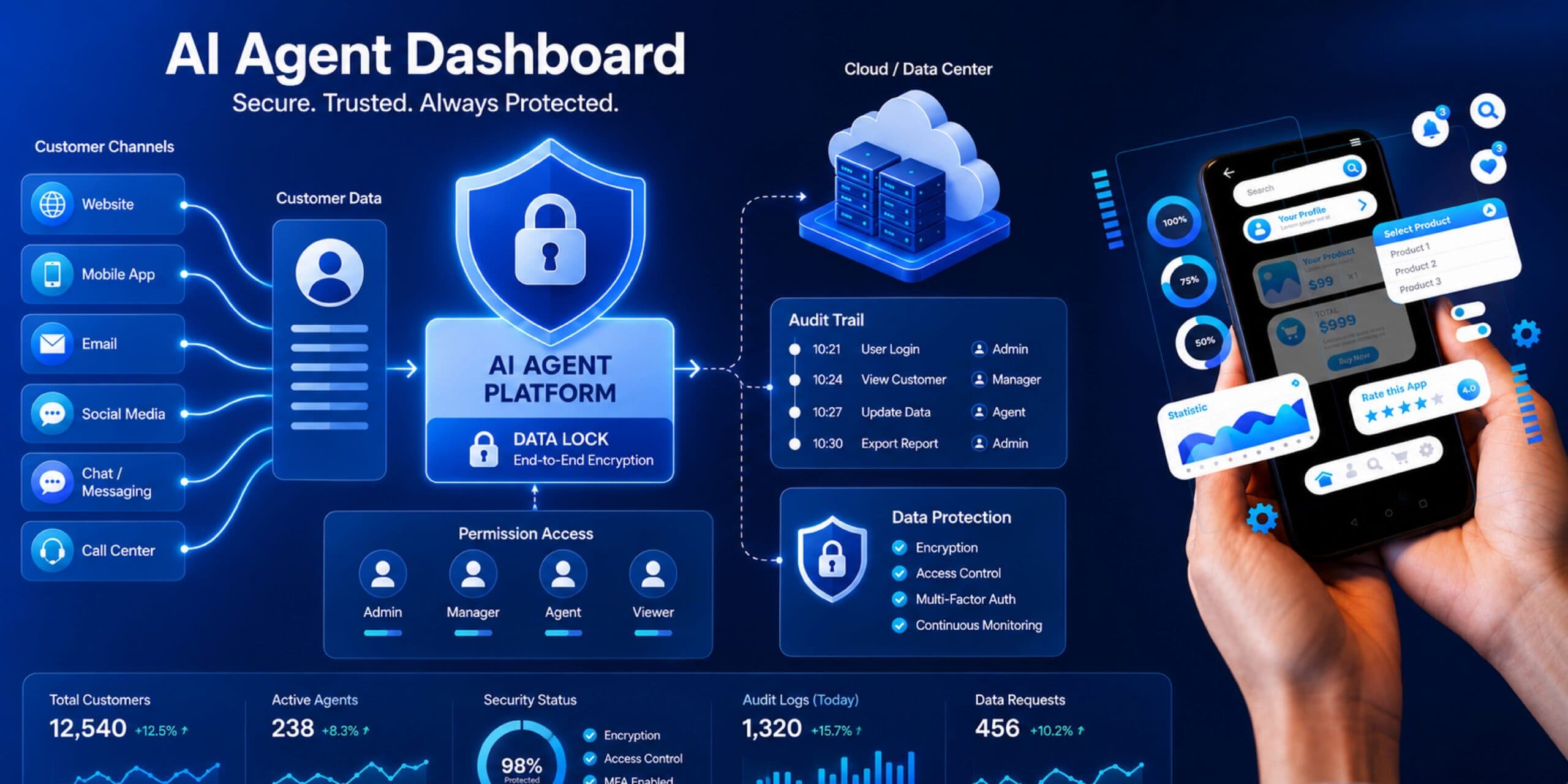
Encryption serves to help protect data both when it’s transmitted and when it’s stored. With the right security approach, conversation data isn’t left exposed without protection — it’s processed through a system designed to reduce the risk of unauthorized access. For businesses relying on WhatsApp, Instagram, live chat, and other digital channels, encryption is an important part of the security architecture because customers move from one touchpoint to another, while the business still needs to maintain data consistency and security at every point of interaction.
At Cekat.AI, the security of customer conversations is part of the platform’s design. We understand that every chat isn’t just an incoming message — it’s part of a customer relationship that needs to be protected. That’s why businesses need a system that not only unifies conversations from various channels, but also helps make sure that conversation data is managed in an environment that’s safer, more structured, and more controlled.
Customer Data Storage Needs to Be Clear, Controlled, and Structured
Besides encryption, another important aspect is customer data storage. Many businesses still store customer data separately across many places — spreadsheets, admin chats, personal contacts, manual notes, internal groups, and files that move back and forth between teams. At a glance, this approach looks practical, but in the long run it actually increases security risk and lowers operational quality.
When customer data is scattered, a business struggles to know which version of the data is most valid, who last contacted the customer, what follow-up status is currently in progress, and who has ever accessed that information. From a security standpoint, this fragmentation weakens control. From a business standpoint, this fragmentation makes the customer journey unclear.
An AI agent integrated with a CRM helps a business manage customer data more centrally. Conversation history, prospect status, tagging, segmentation, and follow-up activity can be managed in one, more structured system. This way, a business not only improves operational efficiency, it also strengthens data governance because customer information is no longer scattered across many places without control.
Cekat.AI helps businesses turn customer conversations into data that’s more organized, segmented, and actionable. But the biggest value isn’t just the ease of managing data — it’s the business’s ability to build a customer engagement system that’s safer and can be monitored. When customer data is stored in a clear system, a business has better control over access, history, segmentation, and customer follow-up.
Permission Management: Not Everyone Needs to See All the Data
AI agent data security can’t be separated from permission management. In day-to-day operations, not every team member needs access to all customer data. A customer service admin may only need to see conversations and ticket status. Sales may need to see prospects, follow-up history, and deal potential. A manager may need to see a performance dashboard. Finance may only need to see information related to invoices or payments. A marketing team may need campaign insight and segmentation, but doesn’t always need to see the full detail of sensitive conversations.
Without clear permission management, the risk of data misuse becomes higher. Overly broad access makes it hard for a business to maintain the principle of least privilege, where every user only gets access appropriate to their role’s needs. In an AI agent implementation, this principle matters a great deal because the system can store a lot of customer information in one dashboard.
Cekat.AI is designed to help businesses manage access in a more controlled way through role division, user permission settings, and a neater work structure. With permission management, a business can determine who is allowed to see certain data, who can handle conversations, who can change a customer’s status, and who can access reports. This approach helps a business maintain data security without hindering team productivity.
Compliance with Indonesian Data Regulations: From PDPA to the PDP Law
In everyday conversation, some people may use the term PDPA when discussing data privacy regulation. However, in the Indonesian context, the correct regulatory term is the Personal Data Protection Law, or UU PDP. This regulation is an important legal umbrella for businesses that collect, store, process, and use customers’ personal data in Indonesia.
For a business implementing an AI agent, the UU PDP needs to be understood not just as a legal obligation, but as a minimum standard of data governance. A business needs to know what data is being collected, for what purpose the data is processed, how consent and the legal basis for processing are managed, how data security is maintained, and how customer rights as data subjects are respected.
In practice, an AI agent implementation that complies with Indonesian data regulations requires collaboration between technology, process, and internal policy. Technology helps secure and organize data. Process helps ensure data is used according to business needs. Internal policy helps the team understand the boundaries, responsibilities, and procedures for handling customer information.
Cekat.AI supports businesses in building customer engagement that’s better prepared for compliance needs. With a more centralized system, more controlled access, and a more structured workflow, a business can reduce the risk of scattered and undocumented data management. For Indonesian businesses starting to take AI agent use seriously, compliance is no longer something that can be postponed. Compliance needs to be part of the implementation design from the start.
Business AI Compliance Starts with Internal Governance
Many businesses assume compliance is only about choosing a secure platform. In fact, business AI compliance also depends heavily on internal governance. A good platform can provide security infrastructure, but a business still needs to define data usage policy, user access standards, sensitive data handling procedures, and periodic evaluation mechanisms.
For example, a business needs to determine what types of customer data are allowed to be entered into the AI agent system. A business also needs to make sure the team doesn’t enter information that’s irrelevant or overly sensitive if it’s not needed for the service purpose. On top of that, a business needs to create procedures for when there’s a change in team members, admin turnover, role changes, or employee offboarding so that access to customer data doesn’t stay open after it’s no longer needed.
Internal governance also includes process audits. A business needs to periodically evaluate whether user access is still appropriate, whether customer data is still relevant to keep storing, whether automation is running according to policy, and whether the AI agent is giving responses within the boundaries the business has set. With consistent audits, a business can keep AI agent use safe, accurate, and aligned with operational goals.
A Secure AI Agent Must Be Controllable, Not Left to Run on Its Own
One of the biggest misconceptions about an AI agent is the assumption that AI works entirely on its own without needing human control. In a business implementation, a secure AI agent actually needs clear boundaries, rules, escalation, and oversight. AI can help answer questions, classify customer needs, suggest responses, or run automatic follow-ups. However, a business still needs to determine when AI is allowed to answer on its own, when it needs to ask for confirmation, and when it needs to hand the conversation off to a human team.
This control matters for maintaining both customer experience quality and data security. For example, for general questions about a product, operating hours, location, or service status, an AI agent can help give a fast response. But for more sensitive cases, such as serious complaints, certain transaction data, requests to change important information, or needs involving special policy, the system needs an escalation mechanism to an admin or the relevant team.
Cekat.AI understands that an AI agent for business shouldn’t just be fast — it also needs to be well-directed. With a configurable workflow, a business can build a conversation flow that fits its operational needs and each industry’s risk level. The AI agent works as a support layer that speeds up the process, while the business still keeps control over data, decisions, and the customer journey.
The Risk of Ignoring Data Security in AI Agent Implementation
Ignoring data security in AI agent implementation can directly impact a business. The first risk is losing customer trust. Customers are increasingly aware that their data has value. When a business fails to protect customer information, the impact isn’t just technical — it’s also reputational. Broken trust is harder to rebuild than fixing an ordinary operational error.
The second risk is operational disruption. If customer data isn’t stored safely and in a structured way, the team will struggle to find conversation history, verify information, or continue follow-up. This can slow down response time, lower service quality, and cause revenue opportunities to be lost because customer intent isn’t handled promptly.
The third risk is compliance risk. As Indonesian data regulations grow stronger through the UU PDP, businesses need to be more careful in managing customers’ personal data. Using an AI agent without clear data governance can create compliance gaps, especially if a business doesn’t know how data is processed, who accesses the data, and how that data is used.
The fourth risk is the leaking of business insight. Customer data isn’t just personal data, it’s also a strategic company asset. Within it is information about demand, purchasing patterns, customer objections, campaign effectiveness, and market opportunity. If this data isn’t managed securely, a business risks not only customer privacy, but also its own competitive advantage.
How to Choose a Secure AI Agent Platform for Business
Choosing an AI agent platform can’t be based only on how sophisticated its features are or how fast it responds. A business needs to evaluate whether that platform has a serious approach to security. A secure AI agent platform needs to be able to help a business manage conversations with encryption, store customer data in a structured way, set up permission management, support a controllable workflow, and provide visibility into customer engagement activity.
A business also needs to make sure the platform can support operational needs across teams. An AI agent doesn’t work in a vacuum. It’s usually connected to customer service, sales, marketing, CRM, automation, and reporting. That’s why security needs to apply across the entire flow, not just at one point in the conversation. A secure conversation whose follow-up data is scattered in a spreadsheet still creates risk. A tidy CRM with uncontrolled admin access still opens up a gap. Fast automation without escalation boundaries can create quality and compliance risk.
Cekat.AI is an AI-powered customer engagement and revenue platform that helps businesses manage chat, CRM, marketing, AI agent, and workflow automation in one system. With this approach, a business can reduce data fragmentation, improve control, speed up customer response, and build an engagement process that’s more secure from the start to the end of the customer journey.
Enterprise Security Standards in Cekat.AI Implementation
As businesses start adopting an AI agent, security needs aren’t only relevant for large companies. Mid-sized businesses, retail brands, clinics, educational institutions, financial services, and B2B companies also need strong security standards because they equally manage customer data. In this context, enterprise security standards mean the platform needs to be designed to support access control, clear data structure, conversation security, user management, and a workflow that can be monitored.
Cekat.AI places security as part of how the platform works. We help businesses make sure customer interactions are no longer scattered across many channels without control, but instead flow into a more centralized, manageable system. We also understand that every business has different security needs, depending on its industry, data volume, team size, customer type, and operational complexity.
For businesses considering an AI agent implementation, security standards aren’t just about avoiding risk. Security standards are a way to build a more sustainable growth foundation. When customer data is secure, the team can work with more confidence. When access is controlled, management can see operations more clearly. When workflows are documented, a business can reduce dependence on manual processes. When compliance is considered from the start, an AI agent becomes not just an automation tool, but part of a more mature business infrastructure.
Data Security as the Foundation of Customer Trust
Customers may not always see how their data is managed behind the scenes. But they feel the impact. They feel it when a business’s response is fast yet still relevant. They feel it when conversation history isn’t lost. They feel it when an admin understands the context without having to ask for the same information repeatedly. They also feel it when a business looks professional, consistent, and trustworthy.
Customer trust isn’t only built through brand campaigns or competitive pricing. Customer trust is also built from how a business manages customer information responsibly. An AI agent can help a business deliver a faster, more personal experience, but personalization only carries value when it’s built on top of secure data governance.
At Cekat.AI, we believe the future of customer engagement isn’t just about who replies to chat the fastest. The future of customer engagement is about who can manage conversations, data, automation, and compliance within one secure, scalable system. Businesses that can do this will have a stronger advantage because they don’t just win attention, they also maintain trust after the customer starts interacting.
AI Agent Data Security FAQ
Is an AI agent safe to use for a business that manages customer data?
An AI agent is safe to use if the business chooses a platform with a clear data security approach, including conversation encryption, structured data storage, permission management, and a controllable workflow. Risk usually appears when an AI agent is used without governance, without access restrictions, or without understanding what data is being processed. That’s why security needs to be part of the implementation from the start, not something thought about after the system is already running.
Can customer conversations be encrypted when using an AI agent?
Customer conversations should ideally be managed through a system that supports data security and protection both during transmission and storage. Encryption helps reduce the risk of unauthorized access to conversation data. For businesses managing conversations from WhatsApp, Instagram, live chat, and other digital channels, conversation encryption is one of the important foundations for keeping customer interactions secure.
How does an AI agent store customer data?
An AI agent integrated with a CRM can help a business store customer data more centrally and in a structured way. Data such as conversation history, lead status, tagging, segmentation, and follow-up can be managed within one system, so it isn’t scattered across spreadsheets, personal contacts, or admin chats that are hard to monitor. Structured storage helps a business improve security while also improving customer engagement quality.
What is the relationship between an AI agent and Indonesian data regulations?
An AI agent can process customers’ personal data, so its use needs to take Indonesian data regulations into account, especially the UU PDP. A business needs to understand the purpose of data processing, the legal basis for data use, consent management, data security, data subject rights, and the responsibilities of data controllers and processors. A good AI agent implementation should help a business build data governance that’s safer and more compliance-ready.
Should every team member be able to access customer data on an AI agent platform?
Not every team member needs to access all customer data. A business should apply permission management so every user only has access appropriate to their role’s needs. Admins, sales, managers, marketing, and finance can have different access needs. With the right access settings, a business can reduce the risk of data misuse while maintaining team work efficiency.
Can an AI agent run without human control?
An AI agent can help automate many processes, but a safe implementation still requires human control. A business needs to set boundaries on AI responses, escalation flows, validation for certain cases, and performance monitoring. A good AI agent doesn’t mean it’s left to work unsupervised — it’s directed so it can help a business work faster without sacrificing security, accuracy, or service quality.
Why is Cekat.AI relevant for businesses that care about data security?
Cekat.AI helps businesses manage conversations, CRM, marketing, AI agent, and workflow automation within one more structured platform. With this approach, a business can reduce scattered data, manage user access, maintain customer journey consistency, and build an engagement process that’s better prepared for security and compliance needs. Cekat.AI is designed to help businesses move faster without giving up control over customer data.
Time to Build an AI Agent That’s Fast, Secure, and Compliance-Ready
AI agent implementation isn’t just a technology decision. It’s a strategic decision about how a business wants to manage customers, data, operations, and revenue in the digital era. The right AI agent can help a business respond faster, keep follow-up more consistent, improve team efficiency, and reduce revenue leakage. But all of these benefits need to be built on top of a strong data security foundation.
For Indonesian businesses, AI agent data security needs to cover conversation encryption, structured customer data storage, permission management, compliance with Indonesian data regulations, and clear workflow control. Without that foundation, an AI agent risks becoming a tool that’s fast but not secure enough. With the right foundation, an AI agent can become customer engagement infrastructure that helps a business grow more efficiently, more trustworthily, and better prepared to meet modern compliance demands.
Cekat.AI is here to help businesses implement an AI agent with an approach that’s safer, more measurable, and relevant to the needs of Indonesian businesses. Learn about Cekat.AI’s security standards and discover how your business can manage customer engagement, automation, and customer data within one platform that’s better prepared for long-term growth.
Read next: State of AI for Indonesian Businesses 2026: Data, Trends, and Predictions