

Imagine this scenario: you browse a product catalog online, even start filling out the website checkout form, but abandon the purchase halfway through. At that moment, you had clear intent, but due to distraction, hesitation, or a busy schedule, the transaction never finalized. Shortly after, a WhatsApp message lands on your phone—crafted not as a generic promotional blast, but as a helpful conversation tailored specifically to you.
This is where an effective WhatsApp retargeting strategy excels. Its objective is not to overwhelm prospective buyers with disruptive sales pitches, but to enter the primary communication channel they already use to ask questions, clarify product details, and receive personalized assistance.
If you want to ensure your business re-engagement workflows operate systematically, securely, and compliantly from day one, you can consult with the conversational growth team at Cekat.ai.
What Is WhatsApp Retargeting and Why Is It Unique?
Simply put, WhatsApp retargeting is a strategy for re-engaging commercial prospects who have previously demonstrated interest in your products or services but exited before finalizing checkout.
What makes it significantly more effective than traditional marketing channels?
- Two-Way Conversational Dynamics: Unlike static display advertisements or one-way promotional SMS, WhatsApp opens an immediate bilateral dialogue. Prospects can reply, ask product-related questions, or seek assistance with checkout barriers.
- Behavioral Context & Segmentation: You avoid sending identical promotional copy to every contact. Messages adapt to user behavioral signals—such as last-viewed product categories, abandoned cart contents, or past support interactions.
- Explicit Opt-In Consent Governance: High-performing retargeting always rests upon verified consumer consent. Clear opt-in permissions ensure messages are welcomed, minimizing spam reports and protecting your business sender reputation.
How the End-to-End Retargeting Workflow Operates
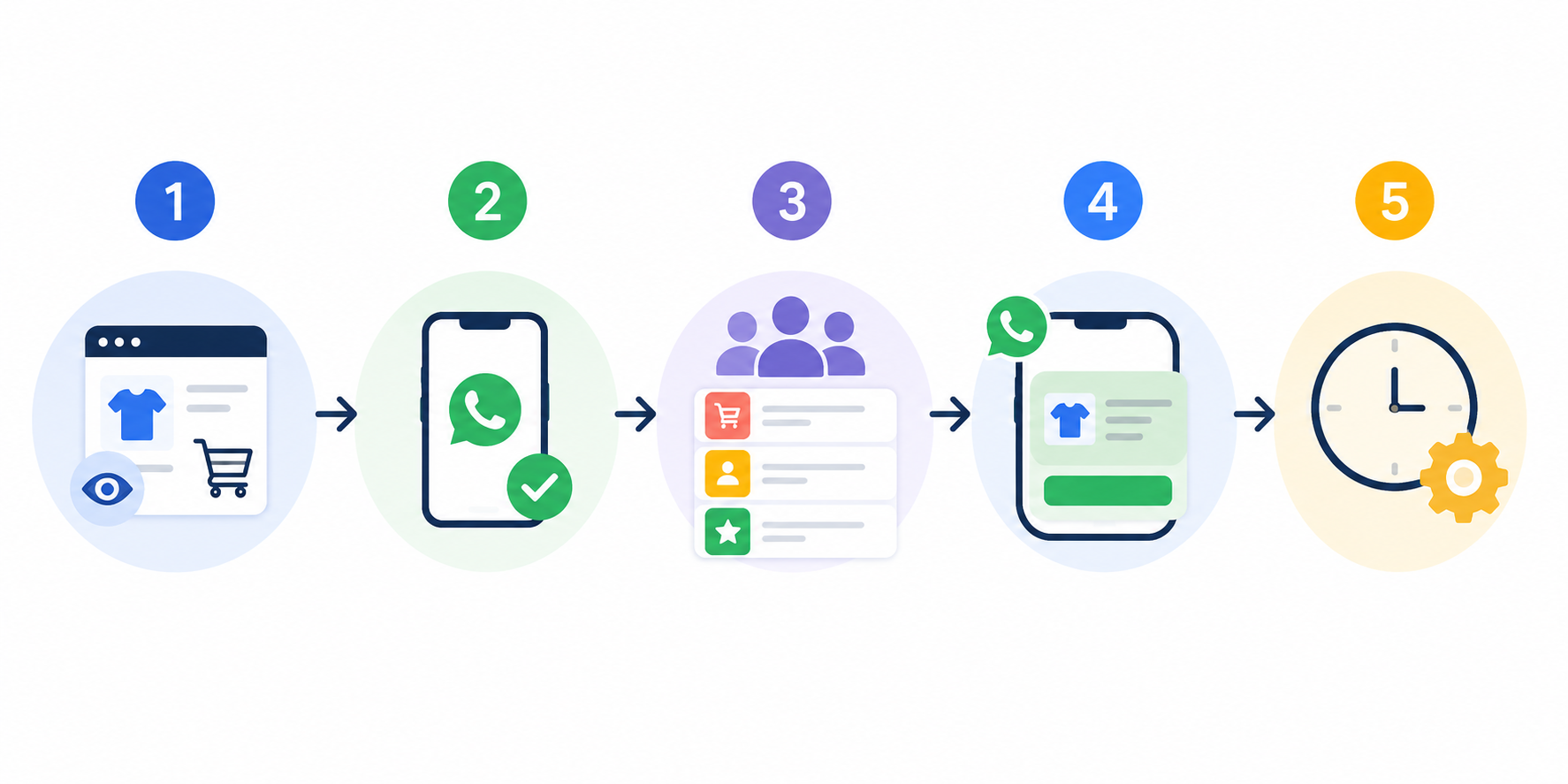
To execute automated, precision-targeted WhatsApp retargeting workflows, implement these structured operational steps:
- Capture Intent Signals: Log behavioral events on your website or mobile app, such as items added to a cart, partial form completions, or repeated product page visits.
- Verify Opt-In Consent: Ensure prospective customers have explicitly agreed (consent) to receive operational and promotional communications via WhatsApp.
- Segment Your Audience: Group contacts based on their funnel position—for example, abandoned cart users, inactive past buyers, or high-intent enterprise leads.
- Craft Concise, Personalized Copy: Draft direct messaging that references the specific product context they viewed and provides an unambiguous Call to Action (CTA).
- Deploy Trigger-Based Automated Timing: Use automation engines to deliver follow-up reminders at optimal intervals—such as 1 to 2 hours after a cart is abandoned.
Key Metrics to Monitor and Optimization Best Practices

To ensure your retargeting campaigns maximize return on investment (ROI) without wasting marketing budget, track these core Key Performance Indicators (KPIs):
- Open & Click-Through Rate (CTR): Evaluates how effectively your message preview and hook capture audience attention.
- Conversational Response Rate: Measures how natural, relevant, and engaging your conversation starters are to the prospect.
- Sales Conversion Rate: Reflects the total volume and value of recovered transactions finalized after retargeting delivery.
- Opt-Out & Block Rate: The primary campaign health metric. Increasing unsubscribe or block rates signal excessive messaging frequency or irrelevant copy.
Related resource: Customer Retention Strategies with Conversational AI Agents
Common Misconceptions and Pitfalls in WhatsApp Retargeting
Many organizations fail to achieve expected conversion gains due to several recurring operational mistakes:
- Neglecting Explicit Opt-In Consent: Blasting marketing messages to leads without verified opt-in permissions solely because they filled a form triggers spam flags and rapid account restrictions.
- Relying on Standard Consumer Apps: Attempting to manage large-scale manual retargeting via personal WhatsApp apps causes response latency and inconsistent customer records. The official WhatsApp Business API is required for enterprise scale.
- Violating 24-Hour Messaging Window Rules: Dispatching unapproved promotional copy outside the active 24-hour customer service window without pre-approved WhatsApp message templates causes delivery failures.
- Over-Relying on Aggressive Discounting: Offering price cuts on every retargeting touchpoint erodes profit margins and conditions buyers to delay orders intentionally to wait for vouchers.
- The “Set-and-Forget” Fallacy: Leaving automated sequences unmonitored without regular audience segmentation audits leads to stagnant conversion rates.
Refining Your Conversational Retargeting Engine
Deploying a disciplined WhatsApp retargeting strategy transforms purchase hesitation into confirmed revenue. By combining verified opt-in permissions, precision behavioral triggers, and helpful conversational assistance, WhatsApp becomes a high-recovery conversion engine for your business.
Moving forward, prioritize continuous A/B testing on message timing, optimize copywriting templates, and streamline checkout UX to maximize overall revenue velocity.
If you want to refine your conversational retargeting workflows and scale your sales pipeline, the team at Cekat.ai is ready to help you architect the ideal operational strategy.


