
Omnichannel Strategy for Indonesian Businesses: Managing WhatsApp, Instagram, and Website on One Platform

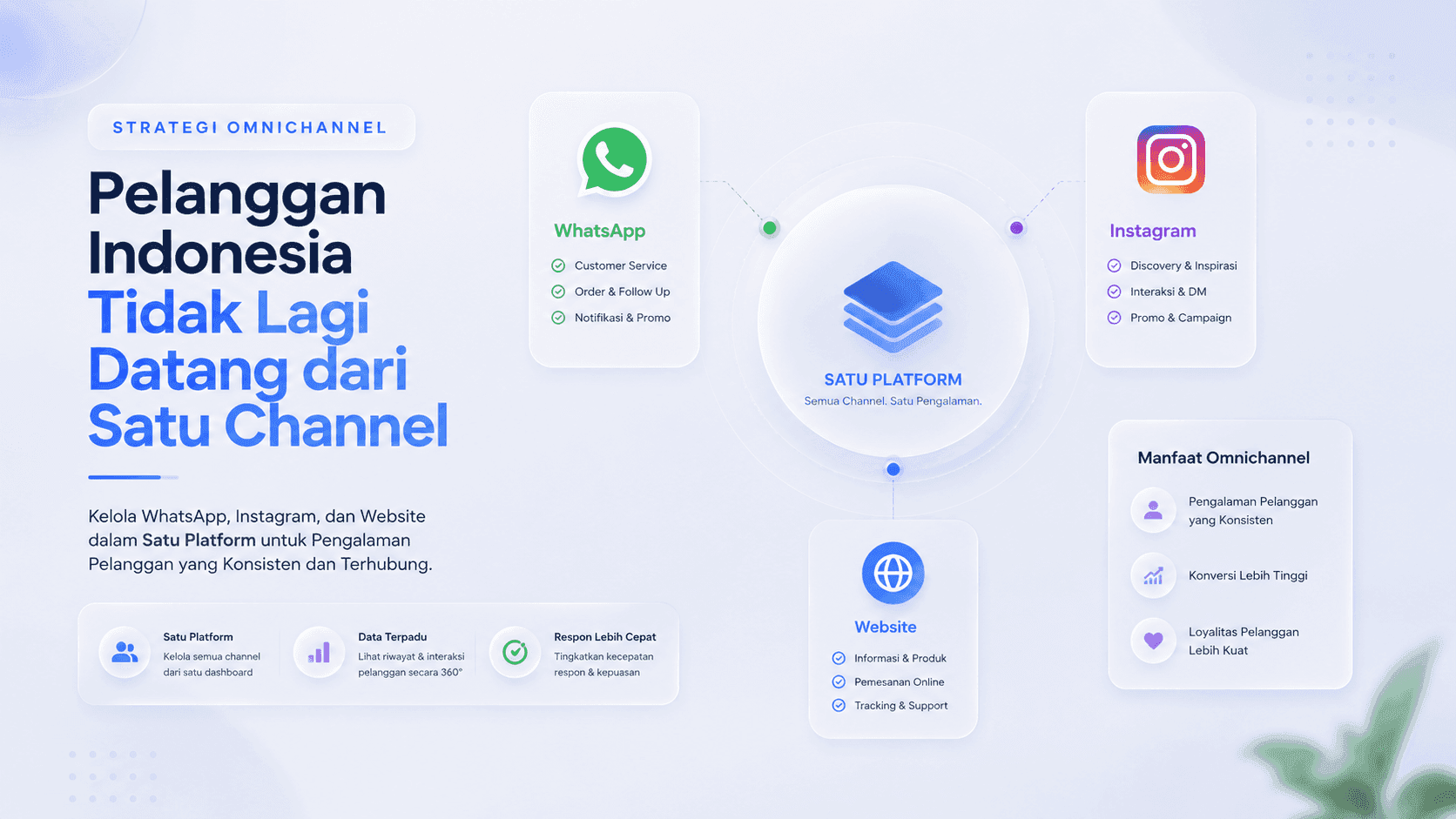
For many businesses in Indonesia, the customer communication problem is no longer simply “how to reply to chats faster.” The challenge has grown more complex: customers ask questions on WhatsApp, reply to a story on Instagram, fill out a form on the website, then send another chat from a different channel. On the business side, all these conversations are often handled by different teams, different devices, and record-keeping systems that are not always connected.
This is where an omnichannel strategy becomes important. For marketing managers and business owners, every customer message is part of the customer journey. One chat that is replied to late can send a lead straight to a competitor. One inquiry that is not recorded can make a campaign look busy without producing optimal conversion. One missed follow-up can become revenue leakage that is hard to trace.
Because of this, an omnichannel strategy for Indonesian businesses across WhatsApp, Instagram, and website is not just about being present on many platforms. What matters more is how a business manages all those channels as a single, connected, measurable conversation system that the team can easily execute on.
Why Indonesian Businesses Need a More Structured Omnichannel Strategy
Indonesian customers move actively between channels. They might discover a brand from an Instagram ad, check its credibility on the website, then ask more detailed questions via WhatsApp. For customers, this movement feels natural. For businesses, however, switching channels often creates operational gaps.
The problem arises when WhatsApp is managed by the sales admin, Instagram DMs are handled by the social media team, and website chat is rarely monitored because it is treated as just a secondary channel. As a result, the customer experience becomes inconsistent. Some customers get a fast response, others wait too long. Some leads are followed up immediately, others get lost because their message is buried among other chats.
For a business that is scaling, this pattern risks holding back growth. A marketing campaign might successfully drive a lot of traffic, but the process after a customer reaches out may not be ready to handle that volume. An omnichannel strategy helps unify these conversation touchpoints so that each channel no longer works in isolation, but becomes part of the same workflow.
Managing WhatsApp, Instagram, and Website on One Platform
An effective omnichannel strategy starts from one simple principle: customers can come from anywhere, but the business team must be able to see and handle them from one place. This is the role of a unified inbox.
With a unified inbox, messages from WhatsApp, Instagram DM, and website chat can all land in the same dashboard. The team no longer needs to keep switching apps to check new messages. Every conversation can be monitored, replied to, given a status, and routed to the right team member.
For a marketing manager, this helps ensure that leads from a campaign do not stop at the engagement stage. When someone clicks an ad, opens the website, then asks a question via WhatsApp or Instagram, that conversation can flow directly into a more organized follow-up process. For a business owner, a unified inbox provides clearer visibility into the team’s response quality, the number of incoming inquiries, and potential opportunities that have not yet been handled.
Cekat.AI helps businesses manage this process through an omnichannel inbox that unifies conversations from various channels on a single platform. So WhatsApp, Instagram, and the website are no longer separate points of communication, but part of a customer journey that can be managed more consistently.
A Unified Inbox Reduces the Risk of Missed Messages
One of the most common problems in managing multiple channels is missed messages. Not because the team isn’t working, but because the system was not designed to handle scattered conversations. When chat volume increases, new messages can pile up. When an admin changes shifts, conversation context can be lost. When a customer switches channels, their previous interaction history is not always visible.
A unified inbox helps reduce that risk by bringing conversations together into a single workspace. The team can see incoming messages from various channels without losing context. Conversations that have not been replied to can be monitored more easily. Leads that need follow-up can be flagged. Repeated questions can be directed to faster, more consistent responses.
The impact goes beyond a tidier operation. Businesses also have a bigger opportunity to maintain customer momentum. In many cases, customers reach out to a business when their interest is at its peak. If the response is late or the message is missed, that intent can fade. With a good omnichannel system, businesses can capture customer interest while the timing is still relevant.
Consistent Response Time Builds Trust
In a competitive market, response speed is part of the brand experience. Customers don’t compare businesses only by price or product. They also judge how quickly a business responds, how clear the information provided is, and how easily they can get help.
The problem is that response time often becomes inconsistent when communication channels are scattered. WhatsApp might get a fast reply because it’s treated as the top priority. Instagram DMs might be delayed because the social media team is focused on content. Website chat might only be active during certain hours. From the customer’s perspective, this inconsistency can feel like unstable service.
An omnichannel strategy helps businesses create a more consistent response standard. With a single inbox for WhatsApp, Instagram, and website chat, the team can work based on conversation priority rather than on whichever app happens to be open. This makes the customer handling process more measurable and helps businesses build trust from the very first interaction.
Cekat.AI sees customer conversations not just as chats that need replies, but as important points in the revenue journey. When response time is more consistent, the chances of turning an inquiry into a qualified lead, a transaction, or a follow-up opportunity are better protected.
An Omnichannel Strategy Helps Marketing See the Customer Journey More Clearly
For marketing managers, omnichannel is not just an operational tool. It’s a way to understand how channels work together to generate demand. Without a connected system, marketing performance is often only visible through surface metrics like clicks, reach, impressions, or the number of incoming chats. Yet what matters more is what happens after a customer starts interacting.
Is a lead from Instagram followed up on? Does a question from the website turn into a WhatsApp conversation? Has a customer who asked about pricing received a follow-up? Does the campaign generate quality conversations, or just traffic without clear intent?
By managing WhatsApp, Instagram, and website on one platform, businesses can see the customer journey more holistically. Conversations are no longer scattered across many apps. The team can more easily understand which channel generates the most inquiries, which topics are asked about most often, and which part of the follow-up process needs improvement.
This is why an omnichannel strategy in Indonesia should be seen as part of a growth system, not just a customer service system. When conversation data is more organized, businesses can make marketing and sales decisions with greater confidence.
From Multi-Channel to Truly Connected Omnichannel
Many businesses feel they are already omnichannel simply because they have WhatsApp, Instagram, and a website. However, being present on many channels does not necessarily mean an omnichannel strategy is actually in place. If each channel is still managed separately, data is not connected, and follow-up depends on an admin’s memory, the business is actually still at the multi-channel stage.
Effective omnichannel requires connection between channels. When a customer asks a question on Instagram and then continues the conversation on WhatsApp, the team should still be able to understand the context. When an inquiry comes in from the website, the business should be able to follow up without losing the initial data. When a customer needs help, the team should be able to see the conversation status and interaction history more easily.
This difference is what makes a unified inbox such an important foundation. Without a unified inbox, omnichannel can easily turn into just a lot of entry points that are hard to control. With Cekat.AI’s unified inbox, businesses can turn conversations from various channels into a workflow that is more organized, measurable, and ready to scale.
Cekat.AI as a Unified Inbox for Businesses Ready to Scale
Cekat.AI helps Indonesian businesses unify customer communication from WhatsApp, Instagram, and website into a single omnichannel inbox. The goal is not just for the team to reply to chats from one place, but for the business to manage the customer journey better from the very first inquiry.
With Cekat.AI, customer conversations can be handled in a more structured way. The team has a clearer workspace to monitor incoming messages, keep responses consistent, and reduce the risk of losing leads because of scattered channels. For business owners, this helps create a more scalable process. For marketing managers, this helps ensure campaign effort doesn’t stop at traffic, but continues into conversations, follow-ups, and conversion opportunities.
In practice, an omnichannel strategy for Indonesian businesses across WhatsApp, Instagram, and website will become even more important as customer expectations rise. Businesses that are fast, organized, and consistent in responding will find it easier to build trust than businesses still relying on manual processes across many apps.
Time to Unify WhatsApp, Instagram, and Website in One Inbox
Customers already move in an omnichannel way. They don’t distinguish whether an interaction starts on WhatsApp, Instagram, or the website. What they expect is a fast response, consistent information, and an easy experience.
Because of this, businesses also need to manage communication in a more connected way. An omnichannel strategy is no longer just an option for big brands, but a necessity for Indonesian businesses that want to reduce missed messages, maintain response time, and turn conversations into more measurable business opportunities.
Cekat.AI is here as a unified inbox to help businesses manage WhatsApp, Instagram, and website on one platform. With a more organized system, teams can work with greater focus, customers get a more consistent experience, and businesses have a stronger foundation to scale.
Try Cekat.AI’s omnichannel inbox for free and start managing all customer conversations from one, more practical platform.
Read next: Key Metrics You Should Be Tracking on a Business Omnichannel Platform