

Executive Summary & Value Proposition
- Legal & Regulatory Compliance: Capture explicit user consent to align with data privacy frameworks and Meta’s official messaging policies.
- Account Suspension Protection: Drastically reduce user spam report rates and safeguard your business phone number’s Quality Rating.
- Marketing Conversion Optimization: Dispatch promotional messages via official wa blast solutions strictly to verified opt-in audiences.
- Integrated Consent Management: Record digital consent audit trails and execute real-time opt-out exclusions using an enterprise CRM application.
In instant messaging digital communications, opt-in consent extends far beyond technical formality. On the official WhatsApp Business API channel, user opt-in forms the essential foundation of legal compliance, customer trust, and long-term business sustainability. Lacking valid consent, outbound messages face high spam risks, messaging limits get restricted, and brand credibility deteriorates rapidly.
This comprehensive guide explores legal, secure WhatsApp API opt-in management—covering data protection frameworks, UX best practices, and technical consent tracking.
What Is a WhatsApp API Opt-In?
A WhatsApp API opt-in is an explicit affirmative consent provided by a customer agreeing to receive communications from a business via WhatsApp. Consent must be clear, verifiable through digital audit trails, and frictionlessly revocable (opt-out) at any time.
Meta strictly mandates that enterprises may only initiate outbound template conversations to users who have provided prior consent—whether for utility notifications, support updates, or marketing campaigns.
Core rules of consent management:
- No opt-in consent → Messages classified as unauthorized spam violations.
- Ambiguous consent → High user complaint risks and automated Meta account restrictions.
Why Is Opt-In Consent Critical for Your Business?
1. Data Protection Regulatory Compliance
Proper opt-in consent ensures compliance with global and local data privacy frameworks (such as affirmative consent, purpose specification, and data minimization). This directly protects customer phone numbers and interaction histories stored within your customer data management system.
2. Customer Trust & High Message Deliverability
Customers who knowingly opt-in demonstrate significantly higher engagement, open messages faster, and rarely report communications as spam—directly elevating overall message deliverability rates.
3. Account Sustainability & Health
Meta security algorithms evaluate business accounts based on user interaction signals and block rates. Proper consent architecture minimizes risks of daily limit downgrades or permanent bans. Learn more in our guide on WhatsApp API compliance with Meta policies.
Valid Forms of Opt-In Recognized by Meta
Opt-in acquisition must require affirmative user action and must never be gathered covertly.
Valid Opt-In Methods:
- Form checkboxes on website registration pages that are unchecked by default alongside clear consent language.
- Interactive CTA buttons stating “Agree to receive order updates via WhatsApp.”
- Explicit secondary confirmation via initial chat message (Double Opt-In).
Invalid / High-Risk Opt-In Methods:
- Implied consent without any active user checking or clicking action.
- Forced opt-in required as an unrelated prerequisite for basic service access.
- Consent clauses hidden deep within confusing legal terms and conditions.
Double Opt-In: Recommended Industry Best Practice
Double opt-in adds a secondary verification layer to confirm that the registered phone number belongs to the user and that they genuinely wish to receive communications.
Double Opt-In Workflow:
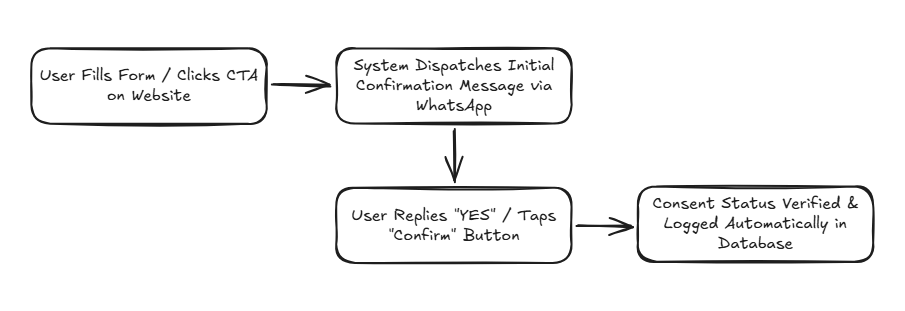
Primary benefits of Double Opt-In include creating rock-solid legal audit proof, eliminating wrong-number dispatches, and building exceptional UX transparency.
Designing High-Converting, Compliant Opt-In UX
A common operational mistake is assuming legal compliance destroys interface user experience (UX). In reality, clear and transparent UX design actively increases opt-in conversion rates.
Effective Opt-In UX Principles:
- Use plain, helpful language rather than dense legal jargon.
- Specify exact message categories (order alerts, CS support, or promotional deals).
- Provide estimated message frequency expectations.
- Display prominent, intuitive opt-out instructions.
Example Microcopy:
“We’ll send order delivery updates and customer support via WhatsApp. Reply STOP at any time to unsubscribe.”
Opt-Out Management: Mandatory, Simple, & Real-Time
Opt-out functionality is the mandatory counterpart to opt-in consent. Meta guidelines require businesses to honor user stop requests without technical friction.
Opt-Out Best Practices:
- Support simple keywords like STOP, UNSUBSCRIBE, or CANCEL.
- Provide interactive “Unsubscribe” buttons on promotional whatsapp broadcast campaigns.
- Process opt-out requests instantly in real-time via workflow automation to exclude numbers from future dispatches immediately.
Technical Consent Management Implementation
To remain audit-ready and secure long-term, organizations must log consent records systematically within their CRM platform.
Essential Consent Audit Trail Parameters:
| Data Parameter | Audit Function & Purpose |
|---|---|
| Phone Number | Recipient’s verified WhatsApp phone number. |
| Timestamp | Exact time and date consent was granted. |
| Opt-In Source | Origin touchpoint (Website Form, QR Code, Checkout Page, etc.). |
| Consent Type | Verification level (Single Opt-In or Double Opt-In). |
| Opt-Out Status | Real-time active/revoked consent status. |
Common Consent Management Mistakes to Avoid
- Importing legacy contact databases from spreadsheets without re-verifying consent.
- Treating business card exchanges or old support chats as promotional marketing consent.
- Failing to sync opt-out statuses in real-time across all marketing software systems.
- Sending promotional marketing blasts when users only consented to transactional utility alerts.
Learn how to avoid account suspensions in our guide on how to avoid spam flags on WhatsApp API.
Manage Compliant WhatsApp API Opt-Ins with Cekat.ai
Managing legal, secure WhatsApp API opt-ins combines regulatory compliance with smart UX design. Enterprise organizations building long-term communication strategies must view consent not as an obstacle, but as a core customer trust asset.
The Cekat.ai platform empowers your enterprise to design compliant, transparent, and user-friendly opt-in workflows. Complete with automated Double Opt-In verification, CRM digital audit trails, and real-time opt-out execution, Cekat.ai ensures messaging campaigns operate safely without phone number suspension risks.
Manage customer consent and execute secure WhatsApp API communications today with Cekat.ai.
Frequently Asked Questions (FAQ)
1. Can I send WhatsApp messages to previous customers without explicit opt-in consent?
For transactional utility notifications (like receipts or order updates), implied transactional consent applies. However, for promotional marketing messages, you must acquire explicit opt-in consent separately.
2. What is the difference between Single Opt-In and Double Opt-In?
Single Opt-In occurs when a user checks a form box on a website. Double Opt-In requires the user to confirm their consent secondary by replying to an initial WhatsApp message.
3. What happens if a business continues messaging a user after they opt-out?
Ignoring opt-outs severely violates Meta policies. Users will report your number as spam, leading to rapid Quality Rating degradation and permanent business account bans.
4. How does Cekat.ai automate customer consent management?
Cekat.ai automatically logs timestamps, sources, and consent statuses in its unified CRM dashboard, instantly excluding contacts from future messaging queues if opt-out keywords are triggered.


