

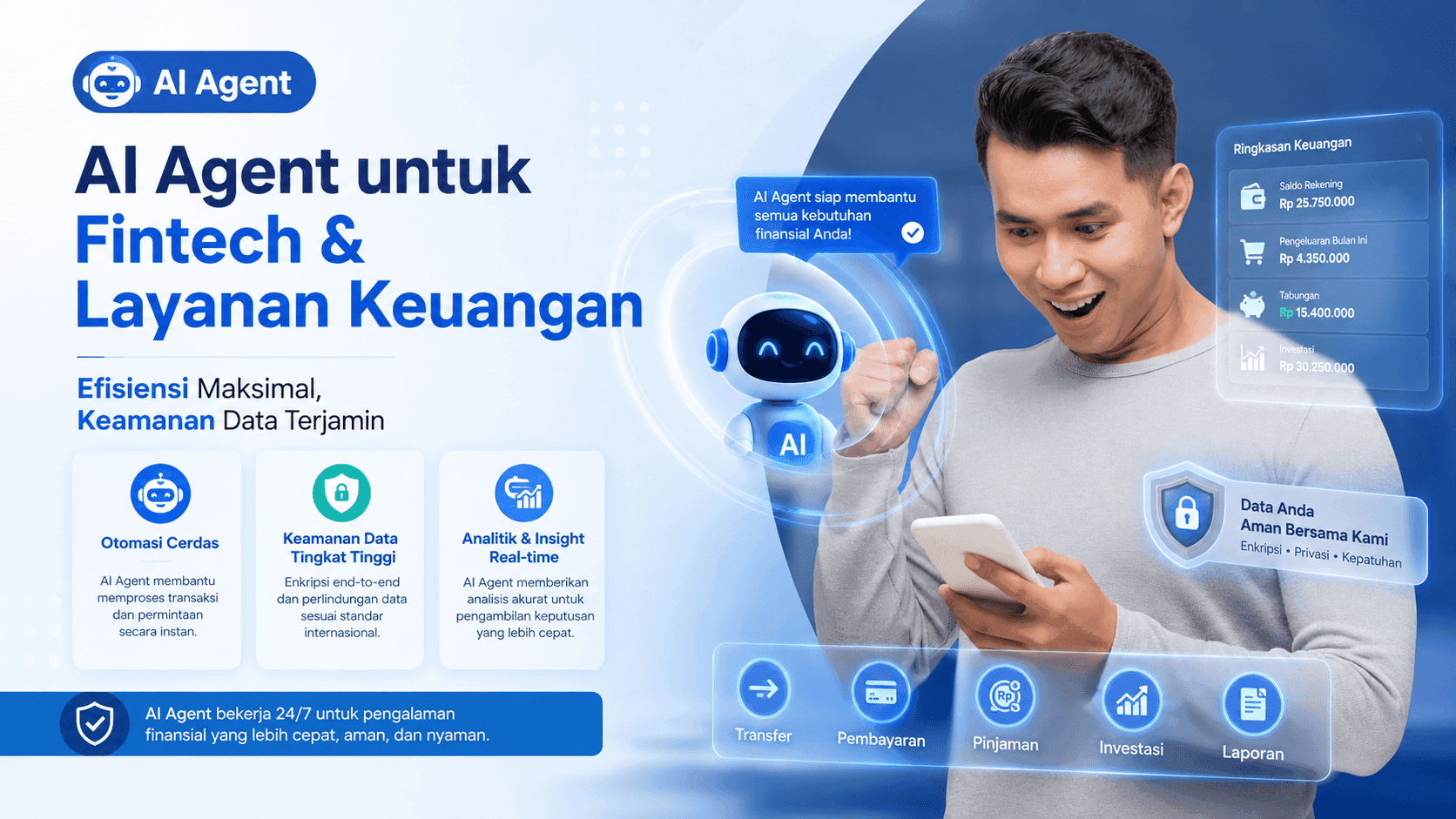
In the fintech and financial services industry, every conversation with a customer carries two major responsibilities: providing a fast response and maintaining trust. Prospective customers want to know product requirements, users are waiting for an OTP, customers need payment reminders, and the customer service team has to answer frequently repeated questions without making the experience feel slow or inconsistent.
The problem is, the larger the volume of transactions and questions, the harder it becomes for operational teams to maintain service speed manually. A delayed response can cause a prospective customer to abandon the process. An undelivered reminder can raise the risk of late payment. Inconsistently answered product FAQs can create confusion. In the financial sector, a small gap in the customer journey can affect efficiency, compliance, and trust.
Because of this, implementing an AI agent for fintech and financial services efficiency and security needs to be seen as part of the operational system, not just a chatbot. AI agents help fintech companies and financial institutions manage customer interactions faster, in a more structured way, and more securely, from initial authentication to transaction notifications.
AI for Fintech as a More Measurable Operational Layer
For fintech founders and financial services managers, the challenge isn’t just answering more messages. The challenge is making sure every interaction moves into a clear process. Has the customer been verified? Has the payment been reminded? Has the product question been answered according to official information? Has the prospective customer been qualified before being passed to the sales team or relationship manager?
This is where AI for fintech becomes relevant. An AI agent can help handle repetitive conversations, guide customers to the next step, log intent, and maintain information consistency across channels. With a more organized workflow, the team no longer has to keep repeating the same answers, while customers still get fast, clear service.
Cekat.AI sees the AI agent as part of the customer journey, not just an auto-reply machine. In the context of financial services, customer conversations need to connect with processes like CRM, automation, follow-up, campaign workflow, and escalation to a human team when needed. As a result, businesses can reduce manual workload without losing control over service quality.
OTP and Authentication That Need Fast, Secure Responses
OTP and authentication are critical points in the fintech user experience. When a user is logging in, making a transaction, or verifying an account, delayed information can immediately create friction. Customers don’t want to wait long just to understand why the OTP hasn’t arrived, how to request a new code, or what to do if the authentication process fails.
An AI agent can help answer OTP and authentication questions instantly, such as guidance on checking the registered number, code expiry time, retry steps, and basic security instructions. For the service team, this reduces the volume of repetitive questions that usually come in all at once during spikes in user activity.
However, for the financial sector, speed alone is not enough. The AI agent must be designed with clear access boundaries. Sensitive information must not be shown carelessly, the authentication process must follow internal policy, and escalation to a human team needs to be available for risky cases. With this approach, the AI agent helps speed up service without sacrificing financial data security.
Automated Payment Reminders to Reduce the Risk of Late Payments
In lending, paylater, insurance, recurring investment, or financial subscription services, automated payment reminders are an important part of customer engagement. Many delays don’t always happen because a customer is unable to pay, but because they forgot the due date, didn’t see the notification, or didn’t understand the consequences of being late.
An AI agent can help send automated payment reminders through the relevant channel, with a message that is clear, polite, and appropriate to the context. Reminders can be set to notify the due date, payment status, payment instructions, or a link to the official channel. With measurable automation, the team doesn’t have to rely on manual one-by-one follow-up.
For fintech and financial services, the benefit isn’t just operational efficiency. Consistent reminders help maintain cash flow, reduce the risk of default due to negligence, and improve the customer experience because communication feels more proactive. At Cekat.AI, automation like this can be part of a broader communication workflow, so reminders don’t stand alone but are connected to the customer journey status.
Consistent Financial Product FAQs Across Many Channels
Financial products often have sensitive details: fees, tenor, limits, interest, risk, eligibility, documents, and the approval process. If information is answered manually by many agents without the same standard, the risk of miscommunication becomes greater. In the financial industry, inconsistent answers don’t just disrupt the customer experience, they can also affect trust.
An AI agent helps AI bank customer service, fintech support, and financial services teams answer product FAQs more consistently. Customers can ask about application requirements, how to activate an account, service fees, process status, or product usage guides. The AI agent then provides answers based on a prepared knowledge base, so information is more controlled.
Importantly, the AI agent doesn’t need to replace the entire customer service role. For simple, repetitive questions, the AI agent can handle the initial response. For cases that need further verification, policy exceptions, sensitive complaints, or potential fraud, the conversation can be escalated to a human team. This model makes customer service more efficient without losing oversight quality.
Qualifying Prospective Customers So the Team Focuses on the Right Prospects
Many fintech companies get inquiries from ads, websites, WhatsApp, social media, or referrals. However, not every inquiry is ready to be processed. Some are just asking questions, some don’t yet meet the requirements, some don’t yet understand the product, and some are actually very promising but not followed up on quickly.
An AI agent can help qualify prospective customers by asking initial questions such as product needs, purpose of use, fund range, type of service sought, area of residence, or document readiness. This information helps the sales, onboarding, or relationship manager team understand follow-up priority.
The impact is that the team doesn’t have to treat all leads the same way. More ready prospects can be prioritized, while colder leads can still be nurtured through automation. This helps reduce revenue leakage from prospective customers who have already shown interest but get lost because manual follow-up isn’t consistent.
Transaction Notifications as Part of Customer Trust
In financial services, transaction notifications are not just alerts. Notifications are part of the feeling of security. Users want to know when a payment succeeds, a top-up arrives, a transfer is processed, a bill appears, or suspicious activity is detected. The faster and clearer the notification, the greater the sense of control the customer has.
An AI agent can help support transaction notifications with communication that’s easier to understand. For example, when a user receives a notification and has a follow-up question, the AI agent can explain what the transaction status means, the estimated processing time, or the next step without making the user wait for a human agent.
For businesses, good notifications help reduce repetitive questions like “has my payment gone through?” or “why is my transaction pending?” With a well-organized automated flow, the support team can focus on cases that genuinely need deeper checking.
AI Financial Data Security Must Be a Foundation, Not an Add-on
Implementing an AI agent in the financial sector must always start from a security-first principle. Customer data, transaction history, identity information, and service conversations are sensitive assets. Because of this, an AI agent should not be judged only by how smart it is at answering questions, but also by how the system manages access, stores data, applies encryption, and supports compliance needs.
Compliance and data encryption are an important part of designing an AI agent for financial services. Businesses need to ensure that the AI workflow doesn’t expose unnecessary data, doesn’t give answers outside policy boundaries, and still follows internal standards as well as applicable regulations. For fintech, security is not an add-on feature; security is a requirement for growing credibly.
Cekat.AI is designed to support businesses that need enterprise-grade security standards. For fintech and financial services, this means the AI agent can be positioned as a solution that helps operational efficiency while maintaining control over data, conversations, and service processes.
Cekat.AI for More Efficient and Secure Financial Services
Fintech companies and financial services cannot rely solely on manual teams to handle growing customer volume. At the same time, automation must not run without security controls. What’s needed is an AI agent that can work within the customer journey in a structured way: helping with authentication, sending automated payment reminders, answering product FAQs, qualifying prospective customers, and supporting transaction notifications.
With Cekat.AI, businesses can manage conversations, CRM, automation, AI agent, campaign workflow, and follow-up within one more measurable system. Teams can work more efficiently, customers get faster responses, and the service process is still built with attention to compliance and data security.
For fintech founders and financial services managers, the question is no longer whether an AI agent can help. The question is which part of the customer journey needs to be fixed first: onboarding, authentication, payments, support, or lead follow-up.
An AI agent solution for financial services starts with a workflow that is secure, fast, and scalable. Cekat.AI helps fintech companies build more efficient customer service without compromising data security.
Read next: AI Agent in the Financial Industry: Efficiency & Security