

Imagine seeing incoming traffic from your Click-to-WhatsApp ads every single day, with plenty of conversations entering your inbox and eventual sales closing. The lingering headache, however, is that you are never entirely certain whether that generated revenue truly justifies your ad spend, or if it was merely a lucky streak of inbound volume.
This is where understanding how to measure WhatsApp ad ROAS becomes critical. Measuring returns on WhatsApp messaging campaigns is not as straightforward as standard e-commerce checkouts due to the conversational latency before a transaction finalizes. Without an accurate measurement methodology, you risk burning ad budget on campaigns that look busy on chat volume but actually operate at a net loss.
If you want to ensure your WhatsApp ad tracking infrastructure and conversion definitions are structured accurately from day one, you can consult with the conversational data team at Cekat.ai.
What Is ROAS and Why Is It Applied to WhatsApp?
ROAS (Return on Ad Spend) is a financial efficiency metric comparing total gross revenue generated from advertising against the total ad spend incurred. In short, ROAS answers the fundamental question: “For every $1 invested in advertising, how much revenue is returned?”
Many marketers still confuse ROAS with ROI (Return on Investment):
- ROAS focuses strictly on direct advertising efficiency against top-line gross revenue.
- ROI evaluates broader business profitability by factoring in all operational expenditures, cost of goods sold (COGS), software subscriptions, and team payroll.
Within the WhatsApp ecosystem, ROAS serves as your primary compass because conversational sales funnels operate uniquely. Ads do not instantly trigger a web checkout; instead, they route prospective buyers into private chat threads. That bilateral dialogue is where commercial transactions finalize. Measuring ROAS helps you determine whether your paid acquisition costs translate into sufficient closed-won revenue from those chat interactions.
How WhatsApp Ad ROAS Measurement Operates
Measuring ROAS across conversational pipelines requires tight telemetry integration between your ad management platforms and backend sales records:
- Establish Clear Conversion Definitions: Define the exact transaction events counted as revenue (such as confirmed bank transfers or completed payment gateway settlements verified by sales agents).
- Consolidate Multi-Channel Data Sources: Implement UTM parameters on your Click-to-WhatsApp ad links to trace campaign origins, cross-referencing metrics within Meta Ads Manager.
- Bridge Chat Conversations with CRM Transactions: Because checkout happens inside chat threads, you must match incoming phone numbers or customer IDs with verified transaction cards inside your CRM database.
- Implement the Appropriate Attribution Model: WhatsApp buyers rarely convert on their first message touchpoint. Multi-touch attribution frameworks distribute revenue credit equitably when buyers engage with multiple ad variations before purchasing.
- Calculate, Analyze, and Scale: Once verified revenue and total ad costs aggregate, calculate your ROAS to reallocate budget toward your most profitable ad sets.
Step-by-Step Guide: Calculating WhatsApp Ad ROAS
Follow these five practical steps to implement accurate WhatsApp ad ROAS measurement:
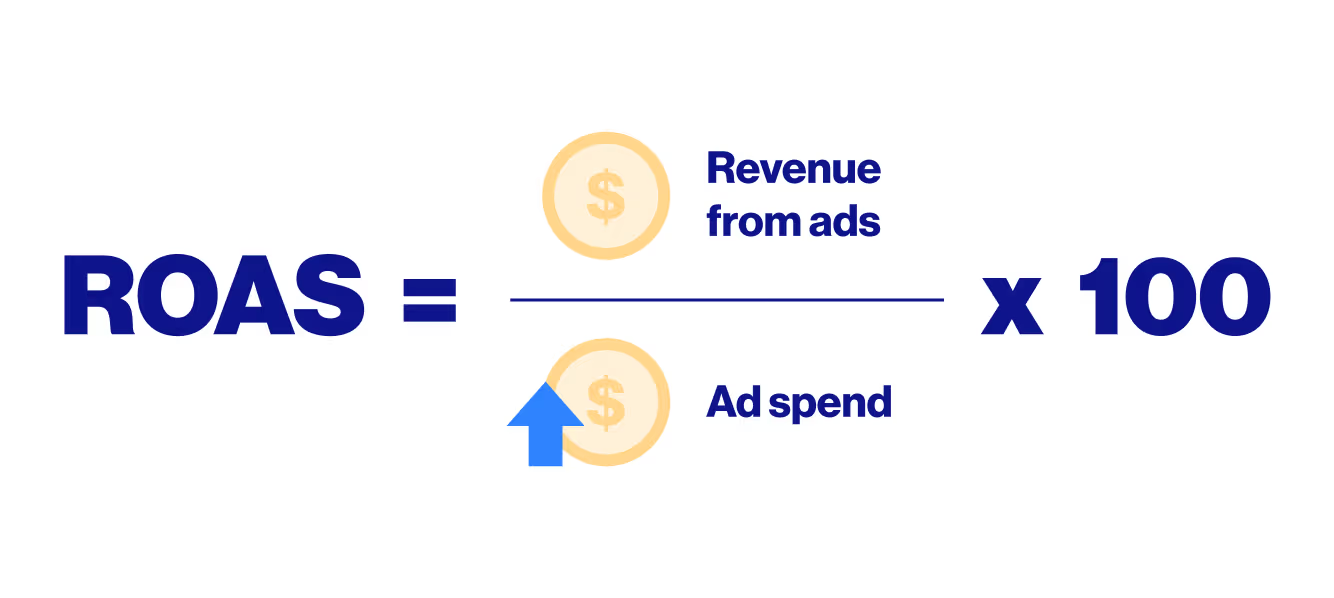
- Apply the Core ROAS Formula:
The fundamental formula is:
$$\text{ROAS} = \frac{\text{Total Revenue from Ads}}{\text{Total Ad Spend}}$$
Example: If you spend $1,000 on Meta Ads and generate $4,000 in confirmed revenue, your ROAS is 4.0 (or 4x / 400%). - Account for Full Advertising Costs Transparently: Do not limit your spend calculation solely to the ad network invoice. Include creative asset production (graphic/video design), affiliate commissions, and supporting martech software fees.
- Verify WhatsApp Revenue Attribution: Ensure you strictly count sales finalized from customers possessing verified tracking trails originating from Click-to-WhatsApp ad links.
- Reconcile Sales Ledgers with Bank Inflows: Cross-reference recorded dashboard orders against actual bank account clearings to prevent data inflation and phantom conversions.
- Interpret Multipliers Against Profit Margins: A ROAS of 1 represents break-even at the ad level. If your product net margin is 25%, you require a minimum break-even ROAS of 4x to ensure your ad campaigns do not incur net operational losses.
What Is a Good ROAS and How Should You Interpret It?
There is no universal benchmark for a “good” ROAS because targets depend heavily on gross margins and campaign objectives:
- ROAS < 1: The ad campaign is unprofitable (ad spend exceeds gross revenue).
- ROAS = 1: Break-even on ad spend (likely operating at a net loss once COGS is included).
- ROAS > 1: The campaign generates top-line revenue exceeding direct advertising costs.
As a general commercial benchmark in retail, a ROAS between 3x and 4x is commonly considered a healthy buffer to protect profitability. However, for campaigns designed to acquire high-value B2B opportunities or consultative leads (lead generation), initial ROAS multipliers may appear lower because full transaction realization occurs over protracted multi-month follow-up cycles.
Common Pitfalls When Measuring WhatsApp Ad ROAS
Several frequent tracking mistakes introduce severe bias into your ROAS calculations:
- Equating High ROAS with True Net Profit: High ROAS figures can be deceptive if product overhead, shipping subsidies, or operational costs are excessive.
- Defining Ad Spend Too Narrowly: Excluding creator content fees, copywriter retainers, and specialized tool costs from your total acquisition expenditures.
- Relying Rigidly on Last-Click Attribution: Last-click models often devalue top-of-funnel WhatsApp awareness ads, ignoring the campaigns that initially introduced the buyer to your pipeline.
- Blaming Ad Campaigns for Slow Sales Agent Responses: On WhatsApp, response speed and conversation quality directly dictate conversion rates. Outstanding ad targeting yields terrible ROAS if inbound chat leads sit unaddressed for hours.
- Auditing ROAS Without Regular Evaluation: Reviewing performance metrics only at the end of the month rather than conducting weekly or daily pacing audits.
Advanced Practices Used by Growth Practitioners

Performance marketing practitioners deploy advanced data strategies to ensure dashboard statistics reflect underlying business health accurately:
- Multi-Touch Attribution Deployment: Distributes fractional conversion credit across multiple customer touchpoints (e.g., discovery ad, WhatsApp consultation, and retargeting reminder) so no touchpoint is misvalued.
- Customer Lifetime Value (LTV) Incorporation: Calculates ROAS taking into account expected repeat purchase value over a 3 to 6-month window from buyers acquired via WhatsApp.
- Rigorous A/B Testing: Continuously splits tests across ad creative hooks, conversational agent closing scripts, and landing page UX to isolate the highest-converting funnel variations.
- Automated Bi-Directional CRM Synchronization: Deploys automation systems to sync WhatsApp conversation statuses directly into sales databases, eliminating manual spreadsheet logging errors.
Actionable Next Steps After Establishing Your ROAS Baseline
Calculating your baseline ROAS is merely step one. Leverage that intelligence to optimize marketing efficiency across five actionable steps:
- Revalidate your conversion definitions to ensure WhatsApp revenue logging captures verified payments accurately.
- Incorporate all indirect acquisition expenses into your centralized ad spend ledgers.
- Audit your attribution windows if WhatsApp sales cycles typically require multiple days of consultation.
- Execute structured optimization sprints on low-performing ad sets by adjusting targeting parameters, messaging creative, and sales rep response velocity.
- Track your performance telemetry continuously to maintain long-term capital efficiency across paid channels.
If you want to ensure your WhatsApp ad ROAS telemetry and conversational tracking infrastructure are reliable and actionable, the team at Cekat.ai is ready to help you architect the ideal measurement strategy.


